

One of the most common phrases patients encounter in cosmetic medicine is “collagen stimulation.”
It appears frequently in marketing, treatment descriptions, and social media content - but collagen biology is considerably more complex than these simplified descriptions often suggest.
Collagen is not simply “turned on” after a treatment.
Rather, the skin is continuously undergoing repair, remodelling, breakdown, and renewal through highly coordinated biological processes that occur gradually over time.
Understanding collagen remodelling helps explain why skin changes with age, why some treatments take time to show visible effects, and why subtle improvements in skin quality often develop progressively rather than immediately.
What Is Collagen?
Collagen is one of the major structural proteins within the skin. It contributes to firmness, resilience, tensile strength, and overall structural support. Within younger skin, collagen fibres are generally more organised and densely distributed. This contributes to skin that appears smoother, thicker, and more reflective.
Over time, however, collagen production gradually slows.
Existing collagen fibres also become increasingly fragmented and disorganised, particularly following cumulative ultraviolet exposure and environmental stress. This contributes to many of the visible features commonly associated with skin ageing.
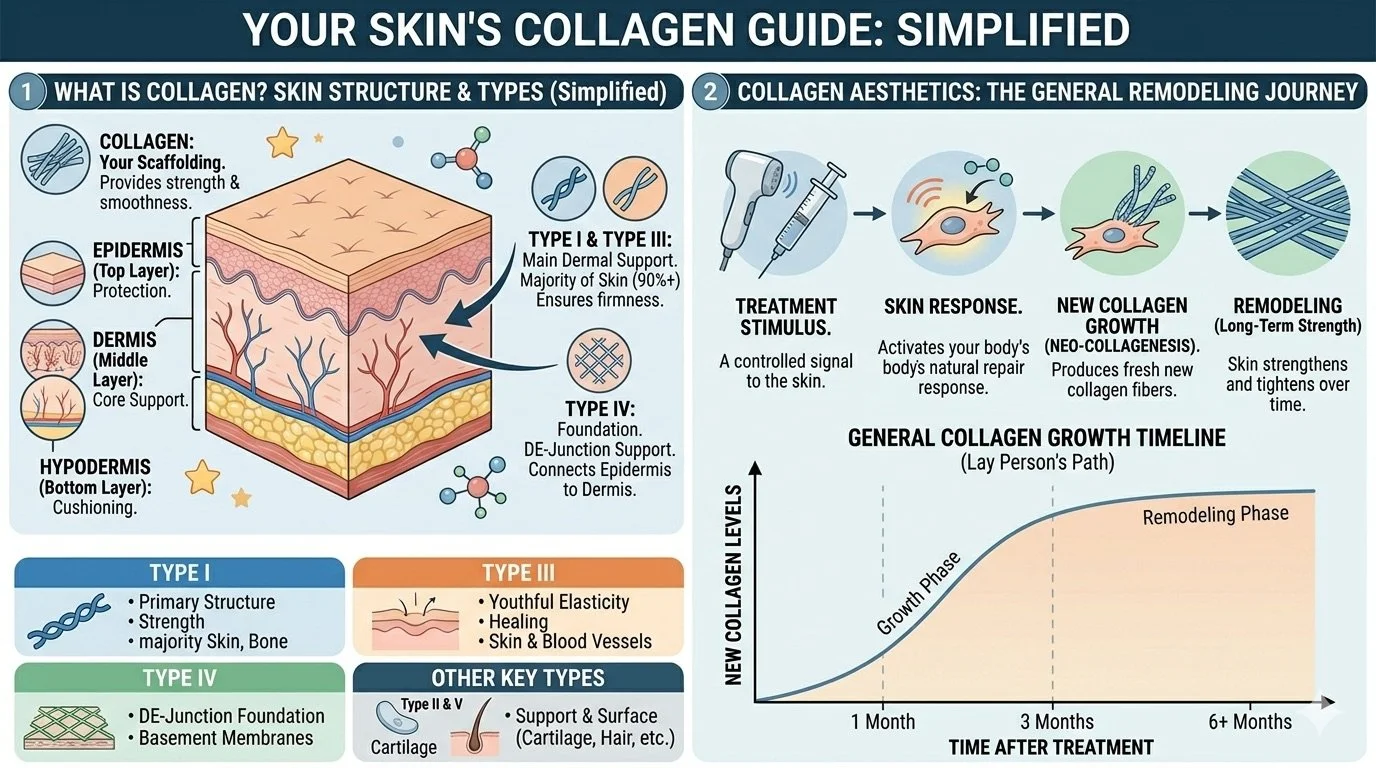
A simplified guide to collagen.
Skin Is Constantly Remodelling Itself
One of the more important concepts patients often do not realise is that collagen is not static. Even healthy skin is continuously changing.
The skin is constantly responding to:
ultraviolet exposure
inflammation
oxidative stress
mechanical movement
hormonal changes
normal ageing
At the same time, the body is continuously attempting to repair and reorganise tissue. This process is referred to as tissue remodelling.
Collagen fibres are gradually broken down and replaced over time through coordinated cellular activity involving fibroblasts, inflammatory signalling pathways, vascular supply, and extracellular matrix organisation. This process occurs continuously throughout life.
Why Collagen Changes With Age
As skin ages, several overlapping biological changes begin to affect collagen integrity. Fibroblast activity gradually slows, collagen synthesis becomes less efficient, and repair signalling pathways become less coordinated. At the same time, cumulative ultraviolet exposure contributes to collagen degradation and oxidative stress within the skin.
Over many years, this contributes to:
thinner skin
reduced elasticity
rougher texture
altered light reflection
slower recovery
reduced structural support
Importantly, these changes usually occur gradually. Most patients do not suddenly notice ageing overnight. Instead, they slowly recognise that their skin behaves differently than it once did.
Collagen Remodelling Takes Time
One of the reasons rejuvenating treatments often require patience is because collagen remodelling itself is gradual. Even normal wound healing unfolds through multiple overlapping phases involving inflammation, cellular signalling, tissue repair, and remodelling. These processes occur over weeks to months rather than days. This is one reason immediate post-treatment appearance can sometimes be misleading.
Patients may notice temporary swelling, hydration, or increased reflectivity shortly after treatment, but these early changes are not necessarily the same as longer-term tissue remodelling.
In clinical practice, more meaningful changes in skin quality are often assessed progressively over time.
Why Skin Quality Matters
Patients often focus on individual lines or folds, but clinicians frequently assess something broader.
Healthy skin quality influences:
reflectivity
texture
elasticity
hydration
resilience
overall facial appearance
As collagen organisation and skin structure gradually change, the face may begin to appear duller, rougher, thinner, or more fatigued even before major structural ageing develops. This is particularly noticeable around the eyes, where the skin is naturally thinner and more delicate. In many patients, improving skin quality can significantly alter the overall impression of the face without creating dramatic visible change.
Why Modern Aesthetic Medicine Has Shifted
Historically, cosmetic medicine often focused heavily on replacing lost volume or treating isolated lines. More recently, however, there has been increasing interest in treatments focused on skin quality, hydration, collagen support, and tissue repair processes. This reflects a broader understanding that healthy skin depends on biological function as much as structural support.
Many patients are increasingly seeking subtle rejuvenation, healthier-looking skin, and more natural outcomes rather than dramatic transformation. As a result, modern treatment planning often focuses on supporting long-term skin quality alongside structural ageing concerns.
Good Treatment Planning Requires Realistic Expectations
One of the difficulties in cosmetic medicine is that patients are often exposed to highly accelerated expectations, but biological repair processes are gradual. In many cases, the goal is not rapid transformation. It is progressive improvement in skin quality, hydration, texture, tissue resilience, and overall skin appearance over time.
The best outcomes are often subtle, cumulative, and natural-looking rather than dramatic.
Most Patients Want To Look Healthier, Not Different
Most patients considering rejuvenating treatments are not trying to completely change their appearance. They usually want to look healthier, less tired, and more refreshed while still looking like themselves.
That distinction matters.
Good aesthetic medicine should not simply focus on visible change. It should focus on understanding the biological processes contributing to skin ageing and developing a rational long-term treatment plan accordingly.
At Cosmenon, consultations focus on assessment, anatomy, skin quality, and long-term treatment planning. Recommendations are individualised following medical consultation and discussion of suitability, alternatives, and treatment goals.