

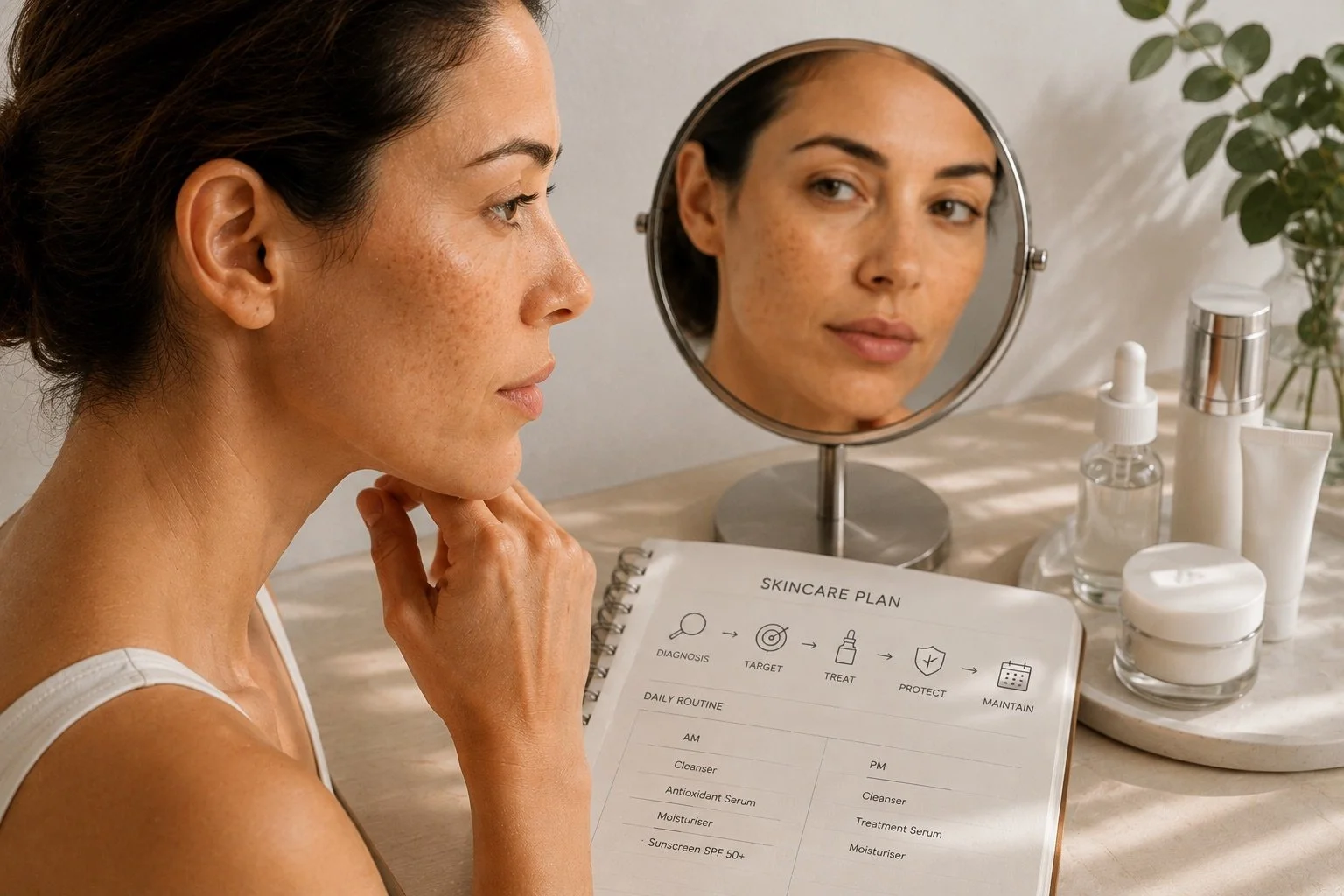
How I Build a Skincare Routine for Pigmentation:
From Diagnosis to Daily Care
"What skincare routine should I use for pigmentation?"
The difficulty lies in the wording of the question.
If two patients arrive with "pigmentation," there is a reasonable chance they will leave with different treatment plans. One may benefit from antioxidant support and a retinoid. Another may require prescription treatment for melasma. A third may need little more than improved photoprotection and patience while post-inflammatory pigmentation gradually fades.
The routine changes because the biology changes, and this is why I rarely begin by discussing products. Instead, I work through a series of questions that help identify what is driving the pigmentation and what the skin needs most.
Step One: Confirm the Diagnosis
Pigmentation is a clinical finding, not a diagnosis. The first consultation is therefore spent identifying the condition responsible for the colour change.
Is this cumulative sun damage?
Is it melasma?
Has it developed after acne or inflammation?
Could medications or hormonal changes be contributing?
Are there features that require referral or further investigation?
Until those questions have been answered, recommending skincare is largely guesswork.
Step Two: Assess the Whole Skin
Pigmentation rarely exists in isolation. The same patient may also have dehydration, reduced barrier function, early collagen loss, enlarged pores, rosacea, persistent redness or signs of long-term photodamage.
Treating only the pigment often produces disappointing results because the underlying skin health has not improved.
This is one reason patients sometimes feel that a pigmentation treatment has "worked," yet their skin still looks tired or uneven.
Healthy skin reflects light more evenly. Texture improves. Hydration improves. Barrier function improves. These changes often make pigmentation appear less noticeable even before every brown spot has completely faded. For that reason, improving overall skin quality usually forms part of every treatment plan.
Step Three: Identify the Treatment Priorities
Every routine is built around priorities rather than products. Reducing oxidative stress from cumulative ultraviolet exposure may be the most important objective. Better control of inflammation before any pigment-targeting ingredients are introduced might be the priority. Someone with melasma may need long-term suppression of melanocyte activity together with meticulous photoprotection. You might have excellent skin health overall, but just need treatment of isolated solar lentigines.
Although these patients all describe "pigmentation," the biology is entirely different.
Step Four: Build the Routine
Once the diagnosis and treatment goals are clear, skincare becomes much easier to personalise. The routine should remain simple enough to be followed consistently while addressing the biological processes responsible for the pigmentation.
Morning
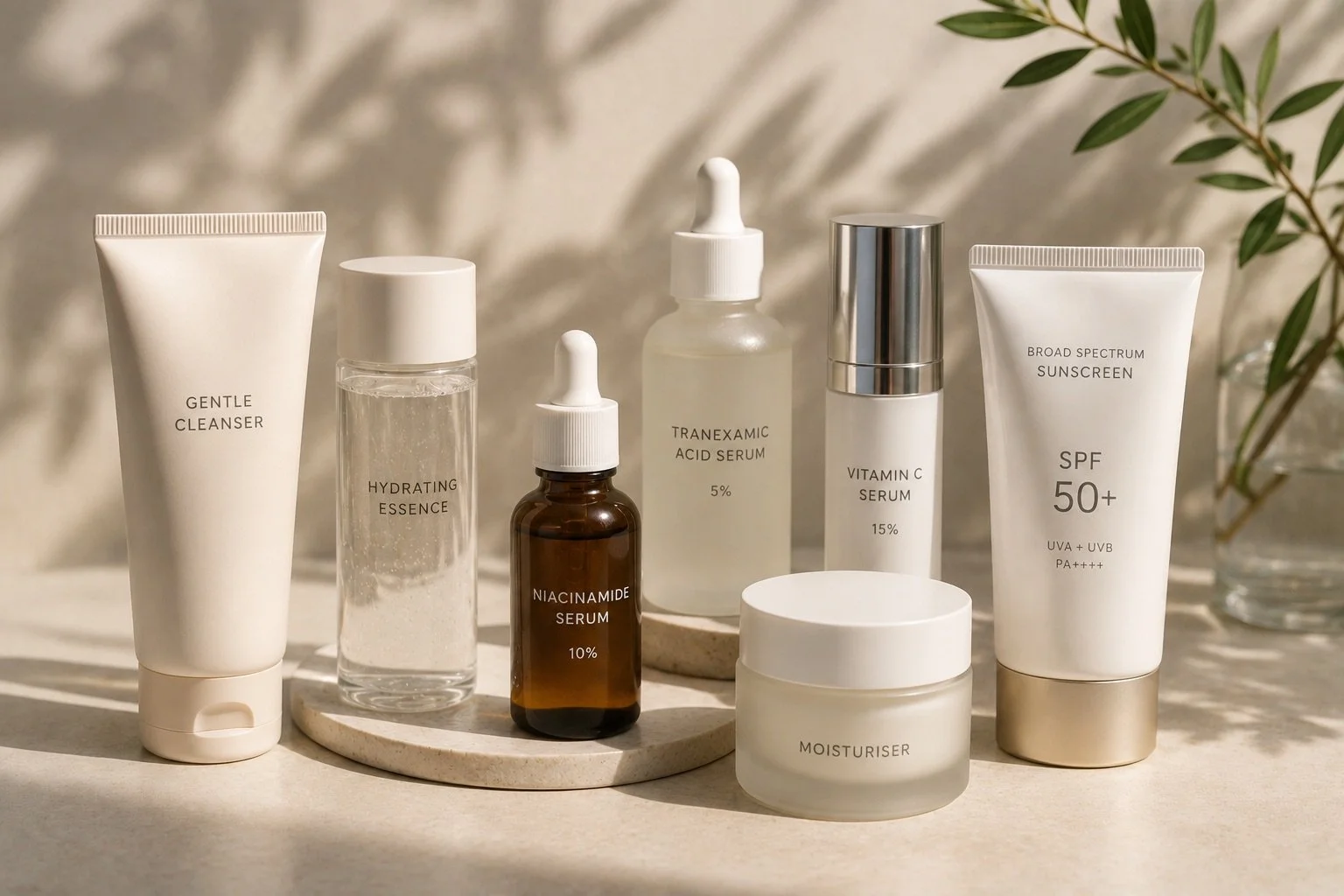
The morning routine is designed to protect the skin from the environmental factors that stimulate melanocytes throughout the day. A gentle cleanser removes overnight oils and skincare residue without disrupting the skin barrier. Depending on the individual's skin, this may include products such as Aspect DR Mild Clean for everyday cleansing or Rejuran Moisture Bubble Cleansing Water when a particularly gentle approach is preferred.
Many patients with photodamage benefit from introducing antioxidant protection in the morning. Stable vitamin C formulations, including Alastin C-RADICAL Defense Antioxidant Serum, may help reduce oxidative stress generated by ultraviolet exposure while also supporting collagen production and overall skin quality.
If barrier support is needed, hydrating products such as Alastin HA Immerse Serum, Aspect DR Ceramide Serum, or selected Rejuran skincare can improve hydration and reduce the likelihood of irritation from active ingredients introduced later.
Every morning routine finishes with broad-spectrum SPF50+ sunscreen. This is the one recommendation that remains remarkably consistent regardless of the type of pigmentation being treated.
Evening
Night-time is when treatment becomes more individualised. Patients with diffuse photodamage may gradually introduce vitamin A derivatives to encourage epidermal renewal, while others may benefit from pigment-modulating ingredients such as tranexamic acid or azelaic acid.
Some patients require prescription therapies including hydroquinone under medical supervision.
When stronger active ingredients are introduced, maintaining the skin barrier becomes increasingly important. Moisturising products should not be viewed simply as comfort products. They improve tolerance of active ingredients, reduce unnecessary irritation and support normal skin repair.
Why I Rarely Recommend Ten Products
Modern skincare marketing often suggests that every concern requires another serum. Pigmentation does not usually work that way.
Most successful routines contain only a small number of carefully selected products used consistently over time. Adding multiple active ingredients simultaneously increases the risk of irritation without necessarily improving outcomes. If irritation develops, it also becomes difficult to identify which product is responsible. A simpler routine is often easier to follow, better tolerated and ultimately more effective.
When Professional Skincare Adds Value
Professional skincare occupies an important position between cosmetic products and prescription medicine. Many formulations contain evidence-supported ingredients delivered in concentrations and formulations designed to maximise stability, penetration and tolerability. This is why I recommend professional skincare when it offers a genuine clinical advantage rather than simply because it belongs to a particular brand.
Some patients may benefit from Alastin C-RADICAL Defense because antioxidant support is the priority. Others may require Alastin A-LUMINATE Brightening Serum as part of a broader pigmentation strategy. Patients with impaired barrier function may achieve better results using Aspect DR Ceramide Serum, Alastin HA Immerse Serum, or selected Rejuran products depending on their hydration requirements and treatment goals.
The decision is guided by the biology of the skin rather than the name on the bottle.
Recognising the Limits of Skincare
One of the most valuable parts of a consultation is recognising when skincare alone is unlikely to achieve the desired outcome. Solar lentigines may respond more effectively to carefully selected laser treatment or intense pulsed light. Melasma often requires prescription therapy alongside meticulous skincare. Persistent post-inflammatory pigmentation may improve only once the underlying inflammatory condition has been brought under control.
Some patients benefit from superficial chemical peels.
Others are better suited to microneedling as part of a broader skin rejuvenation plan.
The important point is that skincare and procedures are not competing treatments. They are complementary. Good skincare prepares the skin for procedures, supports healing afterwards and helps maintain the improvements achieved through clinical treatment.
The Consultation Is Where Everything Comes Together
By the time a patient leaves a consultation, the conversation is rarely centred around a single product. Instead, they understand why the pigmentation developed, which biological processes are maintaining it, what improvements can reasonably be expected and how each component of the treatment plan contributes to those goals.
That plan may include skincare, prescription medications, maybe in-clinic procedures.
More often than not, it includes all three.
The goal is never simply to reduce brown spots - It’s to improve the overall health, function and appearance of the skin in a way that remains sustainable over the long term.
In the next article, we'll look at the point where skincare reaches its limits and explore when prescription medicines, chemical peels, microneedling, IPL and laser treatments become appropriate, and why choosing the right treatment depends on the diagnosis rather than the pigmentation alone.