

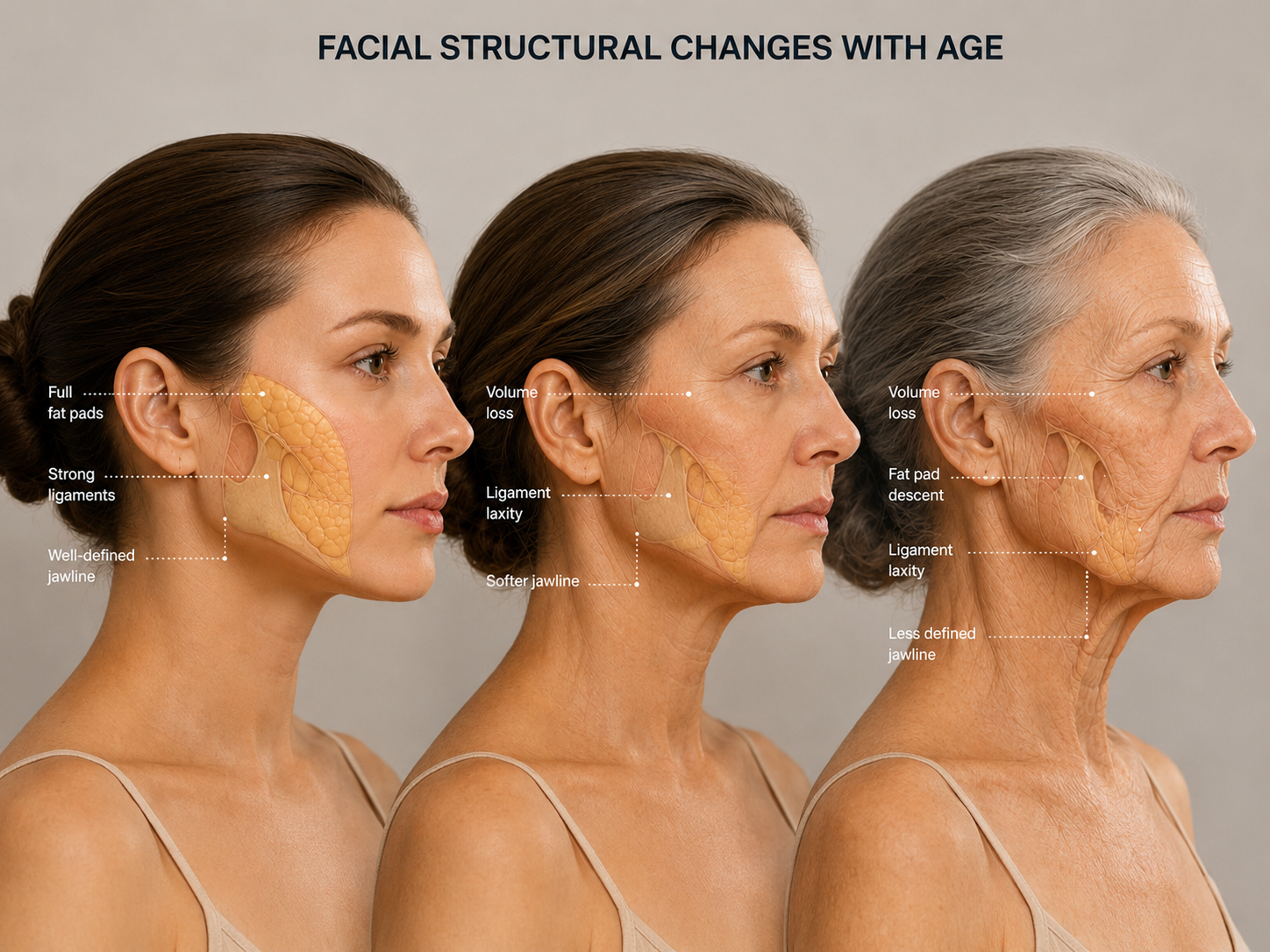
What is Structural Ageing?
People recognise facial ageing when they see it.
They notice changes beneath the eyes. They become aware of increasing heaviness around the lower face. Nasolabial folds become more visible. Marionette lines begin to appear. Their face simply looks different.
These observations are often connected by the same underlying process.
Structural ageing.
Unlike skin ageing, which relates to changes in skin quality, structural ageing describes the gradual changes occurring beneath the skin. These changes influence the shape, support and architecture of the face.
This is important to understand because many of the concerns patients notice are not skin problems at all.
Structural Ageing Is About Support
One of the simplest ways to think about structural ageing is to think about support. When we are younger, the face is supported by a combination of bone, ligaments, fat compartments and healthy skin. These structures work together to maintain shape, contour and position. As we age, those support systems gradually change. The deeper structures become less effective at supporting the tissues above them. At the same time, the skin gradually loses some of its ability to maintain tension. Think of it like the tent poles underneath a tent, providing the support for the canopy.
The result is a face that looks different, even if no single feature appears dramatically altered.
What Patients Notice
Patients rarely arrive at a consultation asking about retaining ligaments or facial fat compartments! Instead, they describe the consequences of structural ageing. The most common concerns I hear involve changes beneath the eyes, increasing heaviness around the lower face, more noticeable nasolabial folds and the development of marionette lines. Many patients describe feeling as though their face is "falling" or "sliding downwards." We’ve all done the “two-finger facelift” and imagined what we would look like.
While these descriptions are not anatomically precise, they do reflect a genuine awareness that facial support has changed.
What Is Actually Changing?
One of the challenges with facial ageing is that multiple biological processes occur simultaneously. The skin gradually loses elasticity, retaining ligaments become less effective at supporting overlying tissues and the facial bones slowly remodel over time. Fat compartments may lose volume in some areas while becoming more prominent in others (frustratingly). Hormonal changes, particularly around menopause, can further influence these processes. None of these changes occur in isolation.
Bone Changes Under the Surface
Patients are often surprised to learn that facial bones change throughout life. The facial skeleton provides the foundation upon which all other tissues rest. As subtle bone remodelling occurs over time, support for the overlying tissues gradually changes. The effects are often most noticeable around the eyes, cheeks, nose and areas surrounding the mouth. You won’t notice bone remodelling directly, but you will notice the changes that result from it.
Fat Does Not Simply Disappear
Another common misconception is that facial ageing is simply a matter of losing volume. Certain fat compartments lose support and volume over time. Others may become more prominent due to descent and changes in surrounding structures. This is one reason why patients may simultaneously feel they have lost volume in some areas while developing heaviness in others. Structural ageing is rarely a story of volume loss alone. It is often a story of redistribution and changing support.
Why Folds Develop
One of the most common questions I hear relates to folds. Patients point to nasolabial folds or marionette lines and ask how they developed. My first thought is rarely the fold itself. Instead, I am asking why the fold has become more prominent. Has support been lost higher in the face? Have the deeper structures changed? Has volume been lost around the cheeks, temples or piriform region? The visible fold is often the consequence of structural changes occurring elsewhere. Understanding the cause is usually more important than focusing on the symptom.
Why The Lower Face Changes
Many patients become increasingly aware of the lower third of the face as they enter their forties and fifties. Jowls become more apparent, and jawline definition can be lost. The lower face can often become heavier.
These changes are often the result of multiple structural processes occurring simultaneously. Loss of elasticity, changes in ligament support, alterations in fat compartments and the effects of gravity all contribute.
Structural Ageing And Menopause
Women frequently notice structural ageing accelerating around the peri-menopausal and post-menopausal years. Changes in hormone levels can influence skin quality, tissue support and body composition. Many women describe increased laxity, weight-related facial changes and a feeling that their face no longer resembles the version of themselves they remember. These observations are often valid. The challenge is that several ageing processes may be occurring simultaneously.
A Doctor's Perspective
One of the biggest misconceptions I encounter is not a misunderstanding about a specific treatment, but a lack of understanding about how the face changes over time - which is normal. You focus on what you can see. A fold. A hollow. A shadow. A jowl.
What you’re not taught is that these visible changes are usually the result of multiple biological processes occurring beneath the surface over many years. This is why facial ageing rarely responds to a single solution. Successful management often requires understanding the interaction between structure, skin quality, lifestyle factors and time itself.
If patients take away one thing from this discussion, I would like it to be this: Structural ageing is not one process. It is the combined effect of changing bone, fat, ligaments and skin occurring gradually over decades.