

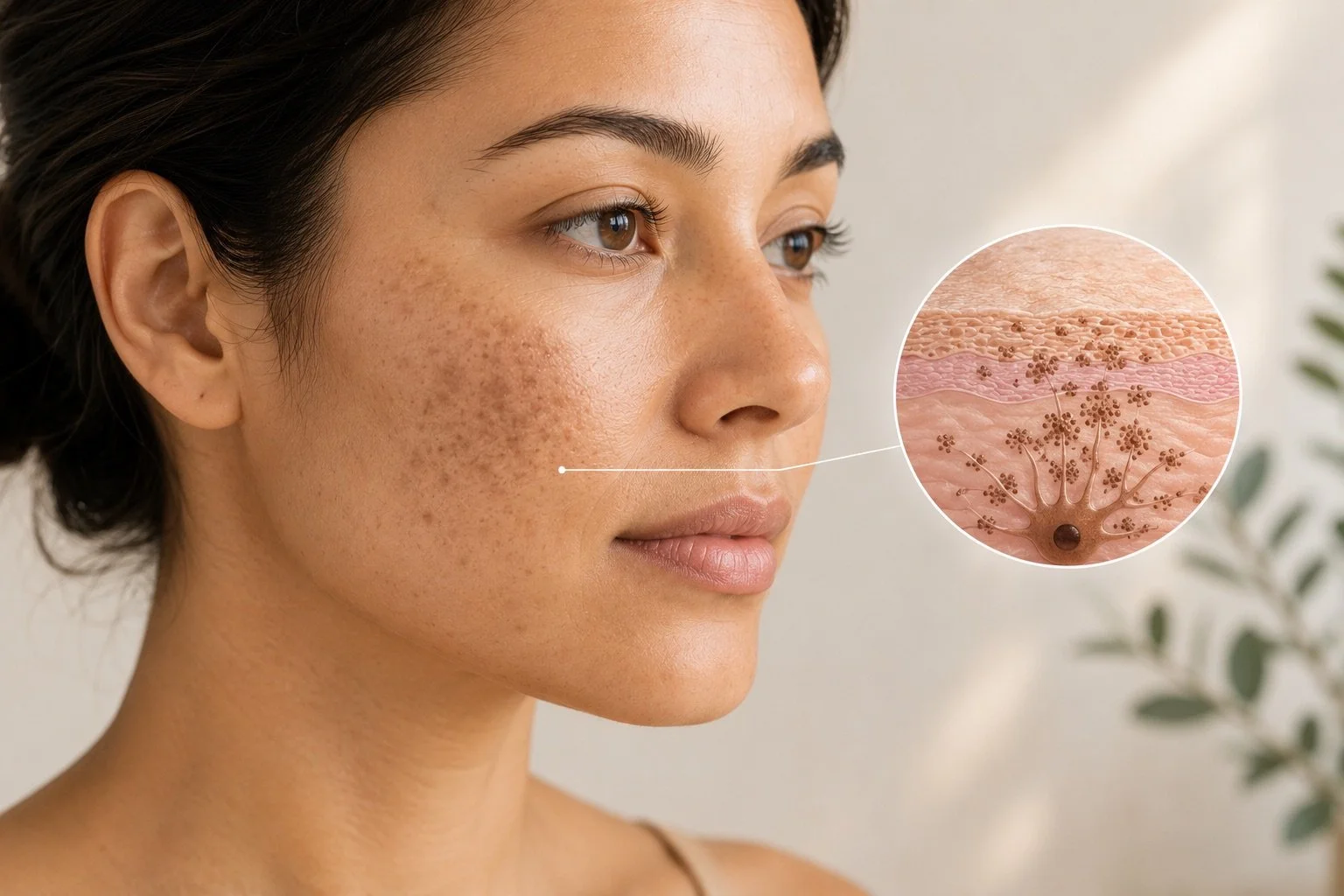
Post-Inflammatory Hyper-pigmentation
Why A Dark Mark Can Last Longer Than The Original Problem
"The acne has gone, so why is the mark still there?"
From the patient’s perspective, the skin should have healed. The pimple settled weeks ago, the eczema flare has resolved, or the scratch has disappeared, but the colour hasn't returned to normal.
In many cases, what they're seeing isn't ongoing inflammation at all - it's the skin responding to inflammation that has already finished.
That response is called post-inflammatory hyperpigmentation (PIH). It is one of the most common causes of uneven skin tone following acne, eczema and other inflammatory skin conditions, and although it often improves with time, the process is rarely as quick as people hope.¹–⁴
Healing And Pigment Are Different Biological Processes
When we think about healing, we usually picture a wound closing or a spot disappearing. Pigment follows a different timetable.
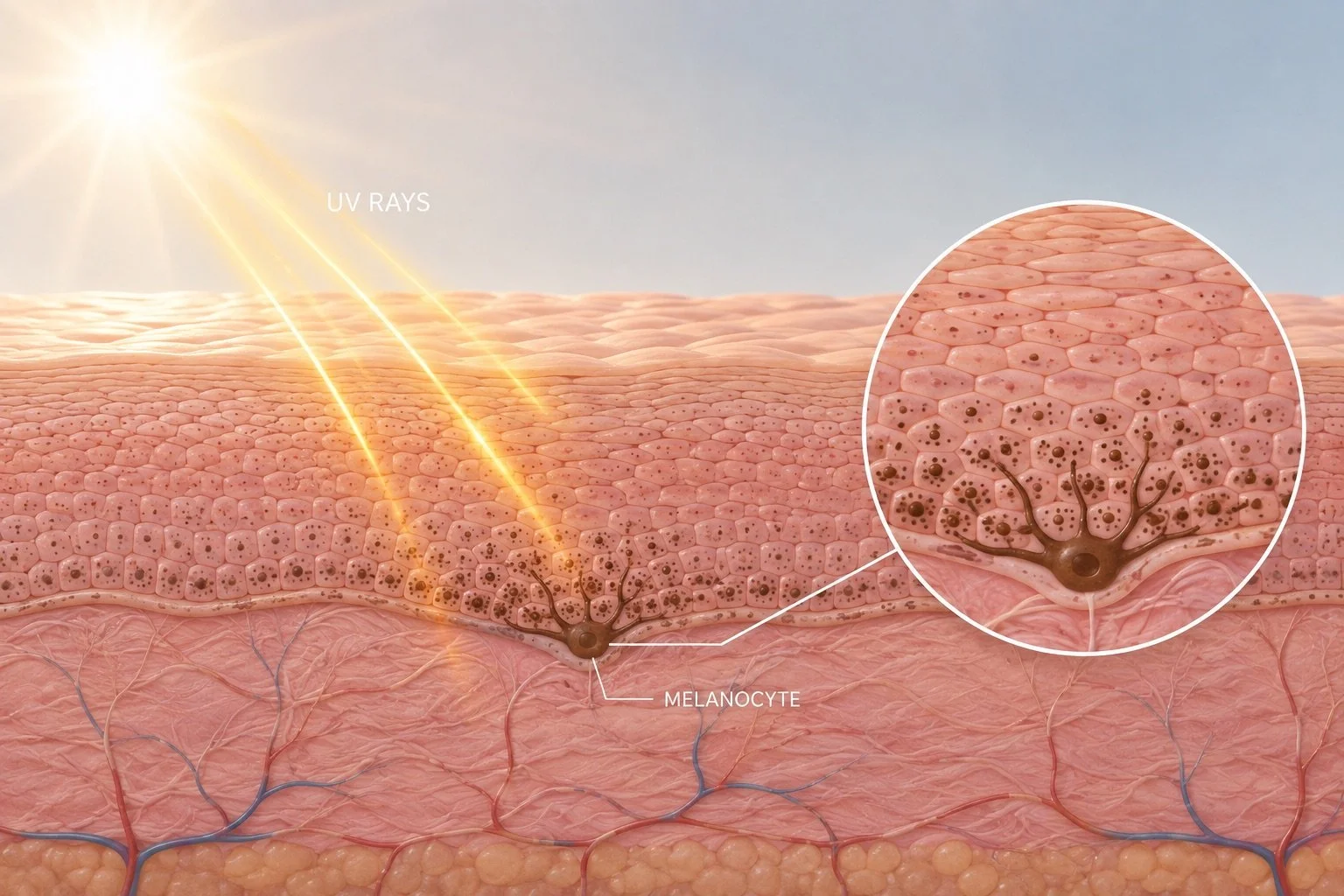
During inflammation, immune cells release chemical signals that help coordinate tissue repair. Those same signals also stimulate melanocytes, the specialised cells responsible for producing melanin. The increase in pigment is thought to represent part of the skin's protective response, even though the inflammation itself may have been relatively minor.¹ ²
By the time the skin surface looks normal again, excess melanin may still be present within the epidermis or deeper dermis. The injury has healed, but the pigment remains.
That explains why patients often feel their skin has "stopped healing" when, biologically, something quite different is happening.
Almost Anything That Inflames The Skin Can Leave Pigment Behind
Acne is probably the best-known cause of PIH, but it is far from the only one.
Any process that creates sufficient inflammation has the potential to trigger increased melanin production. Eczema, insect bites, burns, skin infections, cosmetic procedures, scratches and even persistent rubbing or picking at the skin may all leave residual pigmentation after the original problem has settled.²
The common pathway is inflammation itself rather than the specific diagnosis. This is also why preventing repeated inflammation often becomes just as important as treating the pigmentation that is already present.
Why Skin Tone Makes A Difference
One of the consistent findings throughout the dermatology literature is that post-inflammatory hyperpigmentation is more common, more noticeable and often more persistent in people with darker skin types.² ⁴ This is not because darker skin is unhealthy or heals more slowly.
Melanocytes are naturally more active, and when inflammatory signals are present they are capable of producing a more pronounced pigment response. The biological mechanisms are the same; the magnitude of the response isn’t.
That observation has practical implications during treatment planning. A minor acne lesion that leaves almost no visible mark in one patient may produce pigmentation lasting many months in another.
Why Does It Sometimes Take So Long To Fade?
Patients often assume that if a dark mark is still visible after several months, it must be permanent. Fortunately, that usually isn't the case.
Melanin gradually clears as the skin renews itself, but this is an inherently slow process. Pigment confined to the epidermis generally resolves more quickly than pigment deposited deeper within the dermis, where clearance is considerably slower.¹
The timeline also depends on whether new inflammation continues to occur. Skin that is repeatedly exposed to acne breakouts, irritation or ultraviolet radiation is continually receiving signals to produce more pigment, making meaningful improvement much harder to achieve.
We Shouldn’t Only Focus On The Pigmentation
When I assess PIH, I'm not only looking at the brown mark, I'm trying to understand why it developed.
The pigmentation is often the final stage of a process that began weeks or months earlier. Acne, eczema, repeated irritation (think hayfever season), cosmetic procedures or even habitual picking can all produce a similar-looking result, despite requiring quite different management.
That history influences everything that follows. Continuing to treat pigmentation while the underlying source of inflammation remains active is a bit like repainting a wall without fixing the leak behind it. The appearance may improve temporarily, but the process that created the problem is still there.
Once the cause has been identified and addressed, treatment can focus on supporting the skin as the excess pigment gradually resolves.
Where Does Skincare Fit In?
Once inflammation has been brought under control, skincare becomes an important part of supporting recovery.
Daily sunscreen deserves particular attention. Although ultraviolet radiation did not necessarily cause the original pigmentation, it continues stimulating melanocytes and can prolong the appearance of existing marks. Consistent photoprotection is therefore one of the simplest and most effective ways of supporting pigment recovery while reducing future UV-induced skin damage.¹
Other ingredients, including vitamin C, niacinamide, retinoids and tranexamic acid, may also have a role in selected patients. Rather than recommending the same routine for everyone, I prefer to match skincare to the diagnosis, skin type and treatment goals.
I've discussed these ingredients in more detail in Choosing Skincare for Pigmentation: Which Ingredients Actually Work?
When Is Professional Treatment Worth Considering?
Some cases of PIH improve steadily with time, appropriate skincare and good sun protection but others are more persistent.
Before recommending professional treatment, I first want to establish exactly what we're looking at. Pigmentation following inflammation can resemble melasma, sun damage and several other pigment disorders that develop through entirely different biological pathways.
Only after reaching a diagnosis does it make sense to discuss treatment options. That assessment shapes every decision that follows, from skincare through to any in-clinic procedures that may be appropriate.
How Do I Approach Post-Inflammatory Hyperpigmentation At Cosmenon?
A brown mark on the skin doesn't automatically tell us how it developed. The pattern, distribution, medical history, previous treatments and surrounding skin all contribute to the diagnosis.
That's why I don't begin by recommending a product or procedure, I begin by working out why the pigmentation is there.
From there, we can decide whether the priority is controlling ongoing inflammation, optimising skincare, introducing professional treatment, or simply allowing the skin enough time to complete a process that biology has already set in motion.
Further Reading
This article summarises current evidence from peer-reviewed dermatology literature. Readers interested in exploring the topic in greater depth may find the following publications useful.
References
1. Lawrence E, Syed HA, Al Aboud KM. Postinflammatory Hyperpigmentation. StatPearls Publishing. Updated 2024.
2. Davis EC, Callender VD. A review of postinflammatory hyperpigmentation. J Clin Aesthet Dermatol. 2010;3(7):20–31.
3. Kashetsky N, Feschuk A, Pratt ME. Post-inflammatory hyperpigmentation: A systematic review of treatment outcomes. J Eur Acad Dermatol Venereol. 2024;38(3):470–479.
4. Mar K, Khalid B, Maazi M, Ahmed R, Wang OJ, Khosravi-Hafshejani T. Treatment of post-inflammatory hyperpigmentation in skin of colour: A systematic review. J Cutan Med Surg. 2024;28(5):473–480.