

Skin Quality vs Volume
"I think I need filler."
Usually, my patients are not actually asking for filler.
They’re asking for an outcome.
They want to look fresher, less tired, more youthful. Some describe wanting to "turn back the clock" or "take off twenty years."
The challenge is that patients often arrive having already selected the treatment before fully understanding the problem they are trying to solve. Sometimes volume loss is a significant contributor to their concerns, but often their skin quality is playing a larger role than they realise.
Understanding the difference is important because volume and skin quality are not the same thing. They influence facial ageing in different ways, and they often require different approaches.
What Is Volume Loss?
Volume loss refers to changes occurring beneath the skin. As we age, facial fat compartments gradually change. Certain areas lose support and projection, while others may shift position over time.
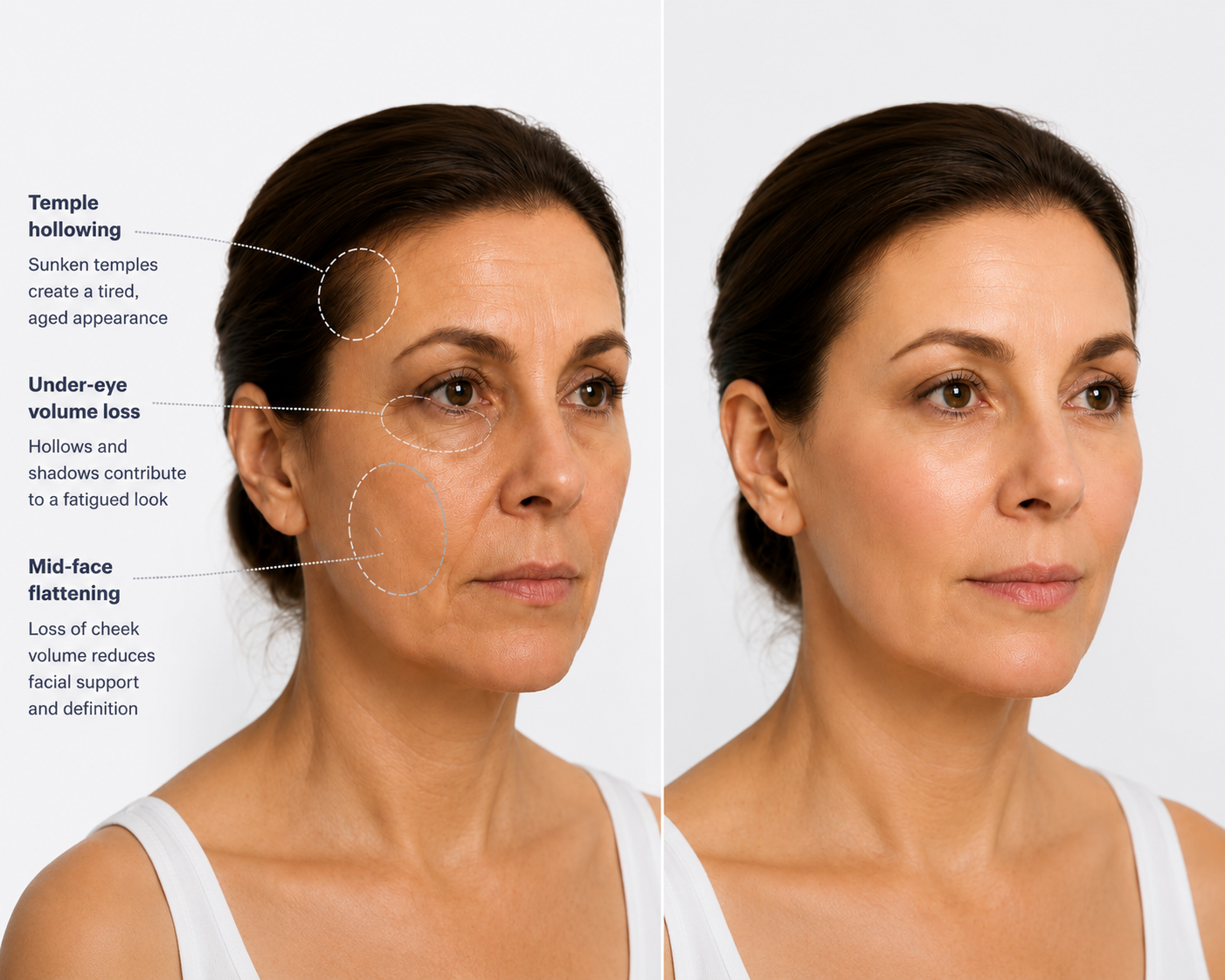
When I assess a patient and believe volume loss is contributing significantly to their appearance, I am often seeing features such as mid-cheek flattening, temple hollowing or volume loss beneath the eyes, and these changes can influence facial contour and shape.
Patients may notice that their cheeks appear flatter than they once did or that shadows have become more prominent.
Volume loss affects the underlying architecture of the face.
What Is Skin Quality?
Skin quality refers to the condition of the skin itself. Rather than focusing on facial shape, I am assessing characteristics such as elasticity, hydration, pigmentation, redness, texture and the presence of static lines. Patients often describe poor skin quality without realising it.
They tell me their skin appears dull. Their makeup no longer sits smoothly. They notice more visible lines or increasing redness around the nose and cheeks. Their skin feels less resilient than it once did.
These observations are often signs of changing skin quality rather than volume loss.
We need to avoid confusing the two.
One of the reasons patients struggle to distinguish between skin quality and volume loss is that both can influence how old, tired or healthy a face appears. A patient may correctly recognise that their appearance has changed.
For example, a patient may point to the cheeks and assume they have lost volume, and sometimes they are right.
Other times, what they are actually noticing is a loss of elasticity, increasing sun damage, uneven skin tone or changes in the way the skin reflects and absorbs light.
What Photographs Often Reveal
Comparison photography is a useful tool. Patients frequently describe feeling as though they have lost significant volume over time, but it’s not uncommon for photographs to reveal a different story.
Volume may have changed only modestly, while skin quality has changed substantially. Static lines may be more visible. Redness may be more pronounced. Pigmentation may have accumulated. Elasticity may have declined. The cumulative effects of Australian sun exposure may have become increasingly apparent - this is a big one.
When patients compare photographs objectively, they are often surprised by what they see.
When Volume Matters
This article is not an argument against filler. When genuine volume loss is present, restoring support and contour can be entirely appropriate. Patients with significant mid-face flattening, temple hollowing or under-eye volume loss may benefit from carefully considered volume restoration. They see immediate results. It can greatly improve their self-esteem.
Volume remains an important component of facial ageing, but the key question is not whether volume matters, but instead how much it matters in comparison to everything else.
When Skin Quality Matters More
One of the recurring patterns I see in practice is patients attributing concerns to volume loss when skin quality is contributing more significantly. The patient may be focused on a fold, a hollow or a shadow. My attention may be drawn instead to elasticity, hydration, redness, pigmentation or cumulative sun damage.
This distinction matters because adding volume does not directly improve many of these characteristics. A patient may have excellent facial volume and still appear older because of poor skin quality. Conversely, a patient with mild volume loss may still appear youthful because their skin quality remains strong.
Why More Volume Is Not Always Better
One of the more surprising conversations I have with patients involves explaining why additional filler may not move them closer to their goals. Sometimes there is already sufficient volume to support the overlying tissues.
Adding more volume may increase risk without providing meaningful benefit, and in some cases, it may even create an appearance that looks less natural.
My own approach is generally conservative.
It always has been and always will be.
Thankfully, aesthetic trends have come around to my way of thinking in the last few years!
The question I am trying to answer is not whether I can add more volume. Instead, how do I help a patient move closer to their stated goals while minimising risk, avoiding unnecessary treatment and maintaining natural-looking outcomes.
A Doctor's Perspective
One of the more common assumptions in aesthetic medicine is that looking younger requires more volume. Volume certainly plays an important role, but when I compare patients of a similar age, it is often skin quality that most strongly influences how healthy, rested and youthful they appear.
Redness, pigmentation, static lines, loss of elasticity and cumulative sun damage frequently contribute more than patients realise.
If patients take away one thing from this discussion, I would like them to understand that volume loss is only one part of facial ageing.
Many patients assume their concerns are primarily related to volume loss. In my experience, skin quality often contributes more significantly than they realise.
Understanding the difference can help patients make more informed decisions and avoid pursuing treatments that may not move them closer to their goals.