

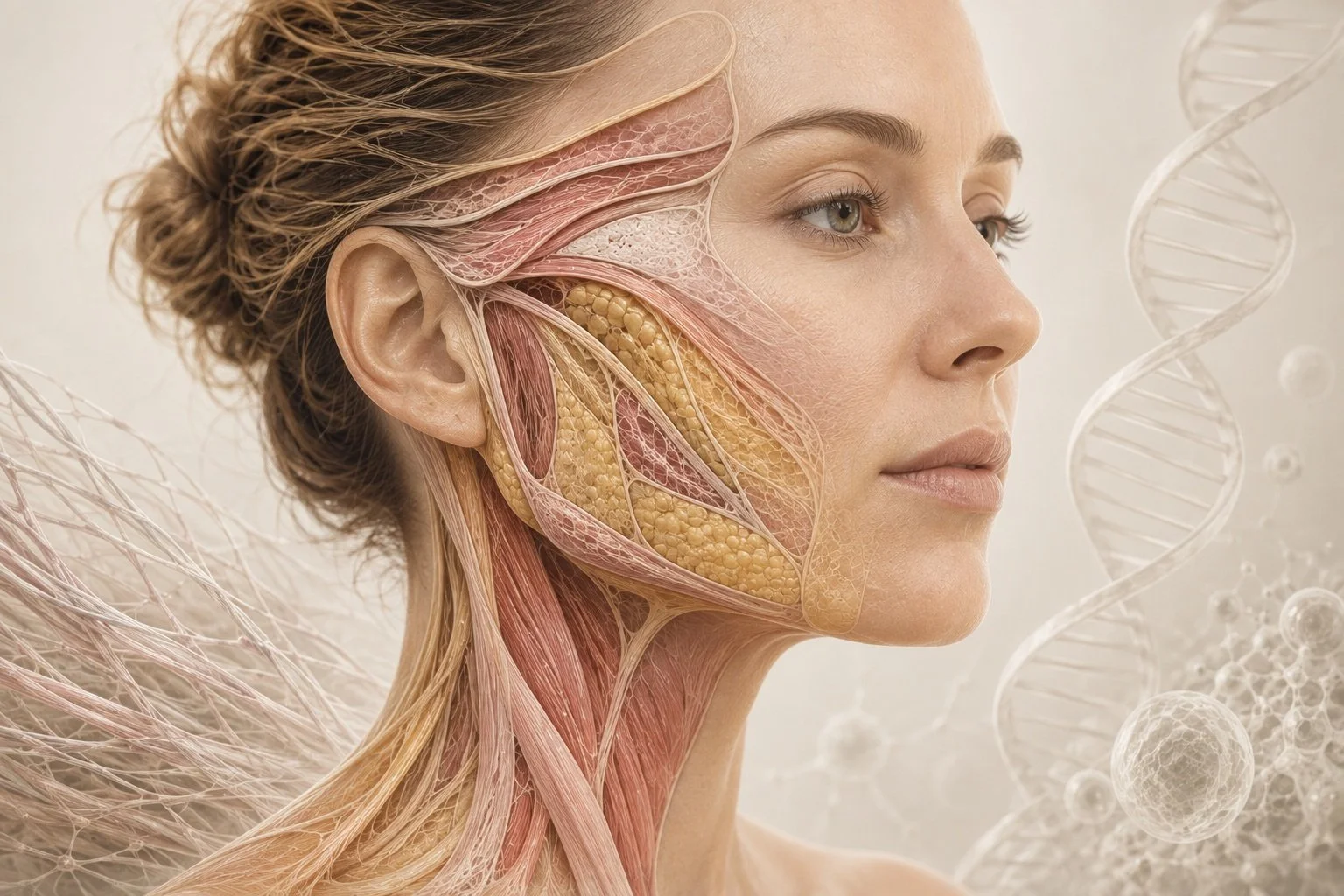
Ageing Well Needs to Start Before Most Of Us Think About It
Ageing does not suddenly begin when we notice a line, a change in skin texture or a loss of facial definition.
By then, many of the underlying processes have already been developing for years.
Skin has been exposed to ultraviolet radiation. Collagen has undergone repeated cycles of damage and repair. Bone, muscle and facial fat compartments have gradually changed. Sleep, nutrition, physical activity, smoking, alcohol, illness and metabolic health have each contributed something to the biological environment in which ageing occurs.
These influences accumulate quietly. Their effects often become visible much later.
This longer view changes the way I think about facial ageing. It places less emphasis on reacting to individual features as they appear and more emphasis on maintaining the tissues that support health, function and appearance over time.
Ageing Is a Continuous Biological Process
In 2013, Carlos López-Otín and colleagues described nine interconnected biological processes known as the Hallmarks of Ageing. The framework was expanded in 2023 to include twelve hallmarks, reflecting developments in ageing research over the intervening decade.
These hallmarks include genomic instability, telomere attrition, epigenetic changes, impaired protein maintenance, mitochondrial dysfunction, cellular senescence, chronic inflammation and altered communication between cells. They are not separate diseases. They describe broad biological changes that develop across tissues and organs as we age.
The skin has its own specialised structure, yet it is exposed to the same systemic influences as the rest of the body. It responds to hormonal changes, inflammation, metabolic health, nutrition, circulation, immune function and the passage of time. It also carries the additional burden of direct environmental exposure.
Facial ageing therefore belongs within a wider conversation about ageing biology. What we see in the mirror is one visible expression of processes occurring throughout the body.
The Difference Between Ageing and Age-Related Decline
Growing older is inevitable (sigh!). The degree of functional decline associated with ageing is much more variable.
The World Health Organisation defines healthy ageing in terms of maintaining the functional ability that supports wellbeing in later life. This includes the physical and mental capacities that allow a person to move, think, see, hear, remember, make decisions and remain engaged with daily life. That definition is useful because it does not promise that ageing can be stopped. It asks what capacity can be developed, maintained or preserved as the years pass. The same principle can be applied to skin and facial ageing.
Skin will still change. I covered a lot of this in the Structural Ageing section. Collagen production slows, elastic fibres deteriorate, pigmentation becomes less even and repair becomes less efficient. Facial fat compartments and underlying bone also remodel with time. The trajectory is influenced by health, environment and behaviour. A person cannot control every part of that trajectory, although several important contributors are modifiable.
Why Prevention Should Begin Before Changes Are Obvious
Many forms of biological damage have a delayed visible effect. Ultraviolet radiation provides the clearest example.
A single exposure may not produce an obvious lasting change, yet repeated exposure activates molecular pathways that degrade dermal collagen and interfere with its production. Over years, the accumulated effects contribute to wrinkling, altered pigmentation, reduced elasticity and changes in skin texture.
Collagen damage also affects the environment in which dermal fibroblasts function. As the extracellular matrix becomes increasingly fragmented, these cells lose some of the mechanical support required for normal collagen production. The result can become self-perpetuating: damaged matrix impairs fibroblast function, which then reduces the skin’s capacity to maintain that matrix.
By the time these changes are visible, they may represent a long history of cumulative exposure and declining repair.
Prevention is most effective during the years when the tissues still have greater functional reserve. Sun protection, resistance exercise, adequate nutrition, smoking avoidance, restorative sleep and management of chronic health conditions do not need to wait for an obvious sign of ageing.
Facial Ageing Involves More Than Your Skin
The visible face is supported by several anatomical layers. Skin contributes texture, pigmentation and surface quality. Facial fat compartments create contour and help maintain transitions between regions. Muscles influence expression and movement. Ligaments provide points of support. Bone establishes the deeper framework. Each layer follows its own pattern of ageing.
Collagen fragmentation can reduce dermal strength. Fat compartments may lose volume or change position. Skeletal remodelling alters support around the orbit, cheeks, jaw and mouth. Repetitive muscular movement gradually influences expression lines.
Prevention cannot preserve every structure in its younger form, nor should that be the expectation. It can reduce avoidable damage, protect function and preserve treatment options for later life.
The Importance of Functional Reserve
The body’s ability to tolerate stress and recover from it tends to reduce with age.
A younger person may recover quickly from poor sleep, illness, nutritional disruption or inactivity. With time, the same stresses can have a more noticeable effect on strength, energy, skin quality and general function.
Maintaining functional reserve involves several connected systems. Muscle supports mobility, glucose regulation and physical resilience. Bone provides structural integrity. Cardiovascular health supports circulation. Sleep contributes to recovery and metabolic regulation. Adequate nutrition supplies the substrates required for tissue maintenance.
These systems also influence the outward signs of ageing.
Skin repair depends on cellular energy, circulation, immune coordination and access to nutrients. Facial appearance can be affected by weight change, loss of muscle, chronic illness, hormonal transition and systemic inflammation.
Starting With the Foundations
A useful prevention plan does not need to be complicated.
Daily sun protection remains one of the most important measures for reducing avoidable skin ageing. Regular resistance exercise supports muscle and bone. Nutrition should provide adequate protein and a broad range of micronutrients. Smoking warrants direct attention because of its effects across multiple organs, including the skin. Sleep, alcohol intake, metabolic health and chronic inflammation deserve consideration within the person’s broader medical context.
Skincare can add value when it is selected for a defined purpose and used consistently. Cosmetic procedures may also have a role, particularly when they are integrated into a longer-term plan rather than used to chase each new change.
No single product, supplement or procedure can carry the responsibility for ageing well.
A Longer View of Facial Ageing
Facial ageing is often managed after changes have become established. There is still value in treatment at that stage, although prevention offers something different: the opportunity to influence the condition of the tissues before extensive correction is being considered.
This may mean protecting collagen from repeated ultraviolet injury, maintaining muscle during weight loss or midlife, treating inflammatory skin disease, improving a poorly tolerated skincare routine, or recognising that a medical issue is contributing to a change in appearance.
The most useful decisions are often relatively ordinary and repeated over many years.
Ageing well develops through that accumulation. It is reflected in the strength we retain, the health of the tissues we preserve, the function we continue to have and the choices still available to us later in life.