

What Happens To Our Face As We Age?
Most people think facial ageing begins with wrinkles.
While wrinkles are certainly part of the process, they represent only one visible sign of a much broader series of changes occurring beneath the skin.
The face is not a single structure. It is a complex arrangement of bone, fat, ligaments, muscles, connective tissue and skin, all working together to create facial shape, support and expression. Over time, each of these layers changes; bone gradually remodels, fat compartments shift and redistribute. Supporting structures become less efficient. Muscle activity leaves cumulative effects on the skin. Collagen production slows and skin quality changes.
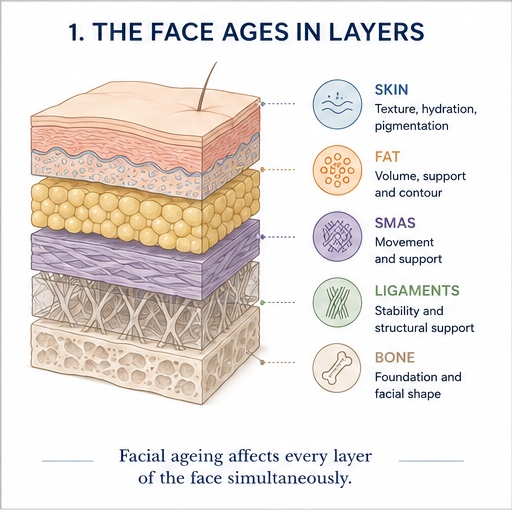
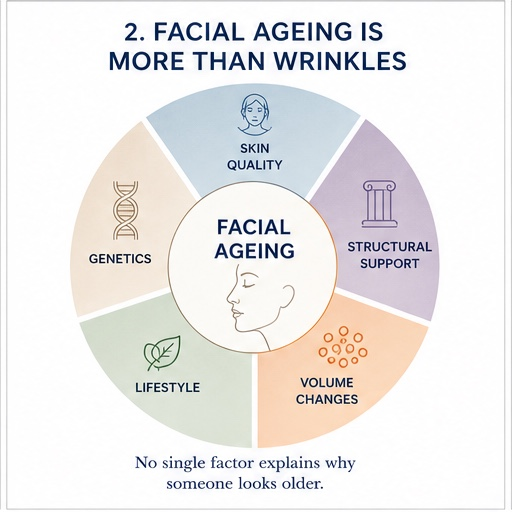
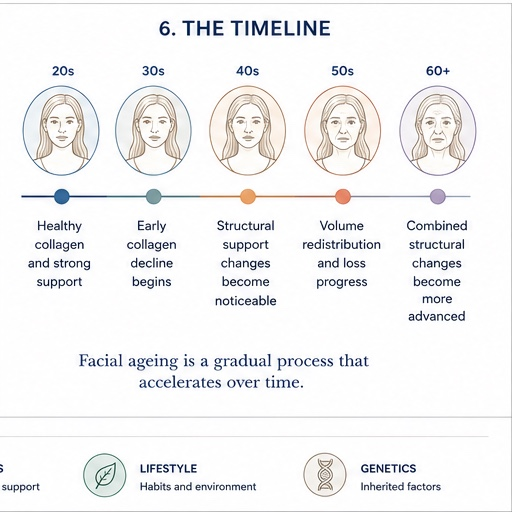
The result is that facial ageing reflects multiple biological changes occurring simultaneously throughout the face. This is one reason why ageing can appear so different from person to person.
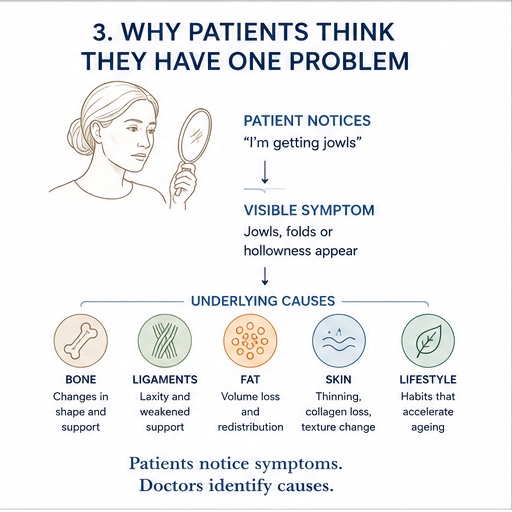
Some individuals notice changes in skin quality first while others become concerned about volume loss, under-eye hollowing, jawline definition or facial heaviness. These observations are different manifestations of the same underlying ageing process, and learning about what’s happening beneath the surface provides understanding as to why your face changes over time and why different concerns emerge at different stages of life.
The Five Processes Of Facial Ageing
At Cosmenon, facial ageing can be understood through five interacting processes:
1. Structure
2. Volume
3. Support
4. Movement
5. Skin Quality
Although these processes are discussed separately, age-related facial changes involve a combination of several mechanisms occurring simultaneously.
1. Structural Changes
The bones of the face form the foundation upon which the soft tissues rest. My patients are surprised to learn that facial bones continue to change throughout adult life. Research has demonstrated gradual remodelling of the facial skeleton with age. Certain areas of the face lose structural projection over time, including regions around the eyes, cheeks and jawline.
As the underlying support changes, the overlying tissues may appear less supported. Facial proportions can alter, contributing to changes in contour and shadowing. While these skeletal changes occur slowly, they help explain why facial ageing involves more than changes to the skin alone.
2. Volume Changes
Facial volume is largely determined by specialised fat compartments distributed throughout the face. In youth, these compartments provide smooth transitions between facial regions and contribute to a rested, healthy appearance. As we get older, fat compartments may shrink, redistribute and descend in different ways.
Common areas where volume changes become noticeable include:
The temples
The cheeks
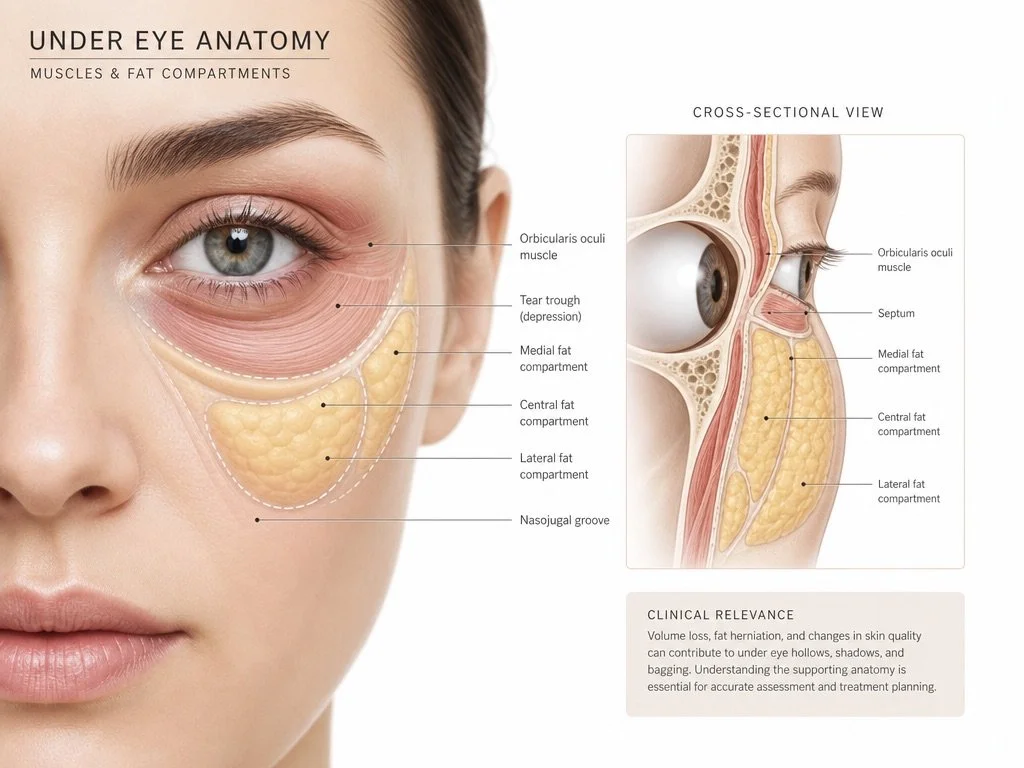
The under-eye region
Around the mouth
Along the jawline
These changes can create shadows and contour differences that patients often interpret as looking tired or older.
Weight fluctuations can also influence facial volume. In recent years, significant weight loss associated with GLP-1 medications has highlighted how rapidly facial volume can change in some individuals. The appearance commonly referred to as "Ozempic Face" is not a disease or complication. Rather, it reflects changes in facial volume that may become more apparent after substantial weight reduction.
3. Changes In Support Structures
The face contains a network of retaining ligaments and connective tissues that help maintain position and support. These structures act like anchoring points between deeper tissues and the skin. Over time, support structures may become less effective. As support changes, soft tissues can shift downward under the influence of gravity and repeated movement.
Patients describe this to me as:
Heaviness around the lower face
Less definition along the jawline
Deepening folds around the mouth
Changes around the neck
These changes are often described as "sagging," although the underlying process is usually more complex than gravity alone. Structural change, volume redistribution and ligament changes frequently occur together.
4. Movement And Facial Expression
Facial muscles are responsible for expression. Every smile, laugh, frown and squint involves coordinated muscle activity. These movements are a normal and important part of communication. Over many years, repeated muscle activity influences the way the skin folds and creases. Initially these lines appear only during expression.
With time, they may become visible at rest. This explains why dynamic expression lines can gradually evolve into more persistent facial lines. Importantly, these changes represent only one aspect of facial ageing. Patients sometimes assume that all ageing is caused by muscle movement, but movement-related changes are only one component of a much broader process.
5. Skin Quality Changes
For many patients, skin quality plays a larger role in perceived ageing. Skin quality refers to a combination of factors including:
Hydration
Collagen content
Elasticity
Thickness
Texture
Pigmentation
Light reflection
Healthy skin reflects light more evenly. As collagen production slows and cumulative environmental damage increases, skin often becomes less elastic, and less efficient at reflecting light.
Patients may notice:
Dullness
Rough texture
Fine lines
Increased pigmentation
Crepey skin
Reduced elasticity
These changes can significantly influence perceived age, even when volume loss remains relatively mild.
One of the common misconceptions encountered during consultation is the assumption that volume loss is the primary problem when declining skin quality may actually be contributing more significantly to the appearance of fatigue or ageing.
Why Different People Age Differently
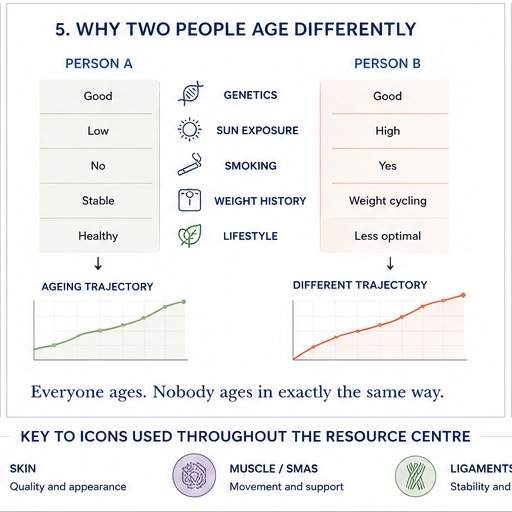
Ageing does not occur at the same rate in every individual, and two people of the same chronological age may appear remarkably different. Genetics plays an important role, but environmental and lifestyle factors also contribute significantly.
Factors associated with facial ageing include:
Sun Exposure
Ultraviolet radiation remains one of the most important external contributors to skin ageing. Cumulative sun exposure can influence collagen breakdown, pigmentation changes and skin texture.
Smoking And Vaping
Smoking has long been associated with accelerated skin ageing through multiple mechanisms including oxidative stress and vascular effects. Emerging evidence suggests vaping may also influence skin health, although long-term data remain limited.
Alcohol
Excessive alcohol consumption may contribute to dehydration, inflammation and lifestyle factors that affect skin quality.
Weight Fluctuations
Repeated cycles of weight gain and weight loss can influence facial volume and tissue support.
Sleep And Stress
Sleep quality, stress levels and general health influence recovery, inflammation and overall skin function.
Nutrition
A balanced diet cannot prevent ageing, but nutritional status plays an important role in maintaining skin and tissue health.
Why We Often Notice Ageing Around The Eyes First
The eye region is often one of the earliest areas where age-related changes become noticeable.
Several factors contribute:
Thin skin
Volume changes
Pigmentation
Light reflection
Fat redistribution
Skin quality decline
Because humans naturally focus on the eyes during social interaction, even subtle changes in this region can have a significant impact on perceived age and tiredness.
Why Looking Tired Is Often Multifactorial
Many patients seek advice because they feel they look tired. Interestingly, tiredness is often not caused by a single anatomical change.
A tired appearance may reflect:
Under-eye volume changes
Skin quality decline
Facial shadowing
Weight loss
Pigmentation
Stress
Lack of sleep
Structural ageing
This is one reason why assessment is often more useful than assumptions. The feature a patient notices first may not always represent the primary cause.
Ageing Is Normal
It is important to remember that facial ageing is a normal biological process. Ageing is not a disease. And every face ages differently.
Genetics, lifestyle, environment and health all contribute to the unique way an individual changes over time.
Understanding these changes is not about pursuing perfection. Rather, it provides a framework for understanding why the face changes and why different concerns emerge at different stages of life.
A Doctor's Perspective
One of the most common misconceptions surrounding facial ageing is the belief that there is a single cause and therefore a single solution. In reality, facial ageing is usually the result of multiple biological processes occurring simultaneously.
Changes in structure, volume, support, movement and skin quality interact continuously throughout life. Understanding these processes often provides greater clarity than focusing on any individual feature in isolation.
For this reason, meaningful assessment usually begins with understanding what has changed before considering what, if anything, should be done about it.