

Why Looking Tired Is Rarely About One Thing
One of the more common reasons patients in their 40s seek advice is surprisingly simple.
They feel well, like, really good. They may be sleeping reasonably well, exercising regularly and functioning normally at work and home. Yet they keep hearing the same comments…
"Are you tired?"
"Did you sleep badly last night?"
"You look exhausted."
After hearing these comments repeatedly, many patients begin to look more closely at their own reflection. Often, they start noticing changes beneath the eyes or around the cheeks and assume they have found the cause. Interestingly, this is not always what I find during an assessment.
Many patients believe they look tired because they have lost facial volume or appear gaunt. More commonly, I see changes in skin quality, elasticity and light reflection that have developed gradually over time. Years of cumulative sun exposure, lifestyle factors, hydration status and dietary habits often contribute more significantly than patients realise.
This is particularly relevant in Australia, where decades of ultraviolet exposure can influence skin quality long before people begin thinking about facial ageing.
One of the most important observations I have made is that looking tired is rarely caused by one thing.
More often it is the cumulative effect of several subtle changes occurring together.
Why We Associate Certain Facial Features With Fatigue
Humans are remarkably good at interpreting faces. Within seconds of meeting somebody, we unconsciously form impressions about their mood, health and energy levels. We are particularly sensitive to changes around the eyes because this area naturally attracts our attention during conversation.
As facial contours change and skin quality evolves over time, the way light interacts with the face changes as well. Areas that once reflected light evenly may begin to cast subtle shadows. The result is that a person can appear tired despite feeling perfectly well.
Looking tired and being tired are not necessarily the same thing.
The Under-Eye Area Is Often Blamed First
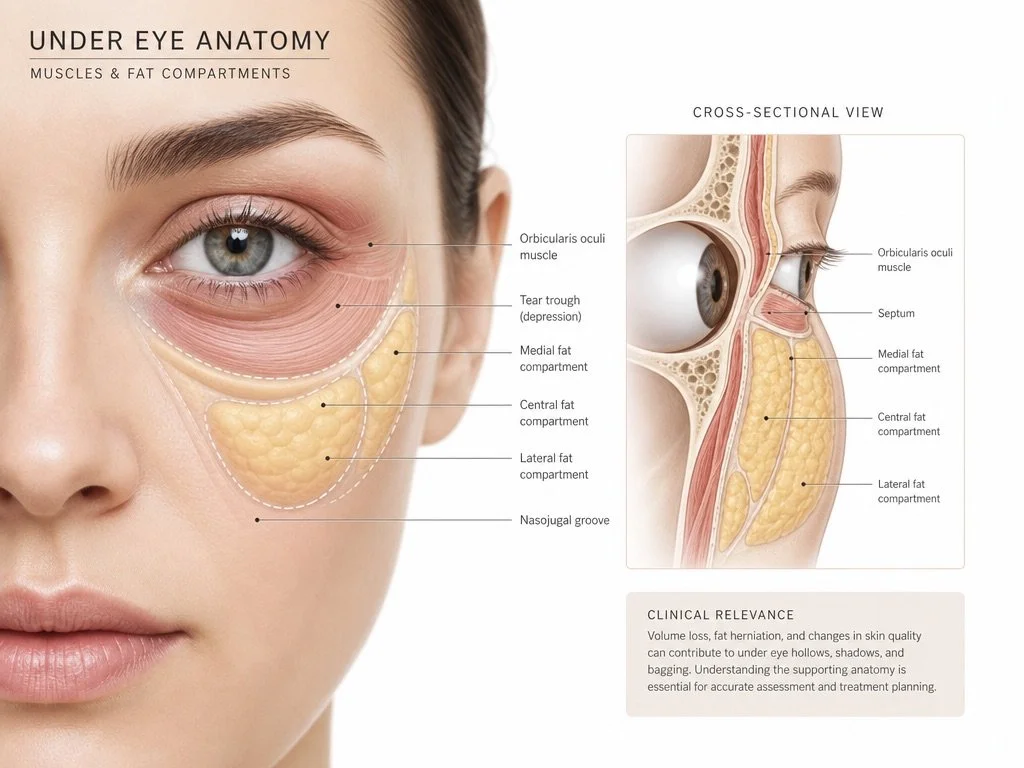
When patients describe looking tired, they will often point directly beneath their eyes, and this is both common and understandable. The under-eye area plays a major role in how rested or refreshed we appear, but one of the most common misconceptions I encounter is the belief that all under-eye changes have the same cause.
Dark circles and under-eye changes can be surprisingly complex. Similar appearances may arise from vascular changes, pigmentation, atopic skin conditions, cumulative sun exposure, volume changes, or broader alterations in skin quality. In many patients, several of these factors are present simultaneously.
This is why two people may appear to have similar under-eye concerns while the underlying explanation is completely different. Same concern, different biology.
The Cheeks Often Tell An Important Story
After the under-eye area, patients frequently point to their cheeks. They describe looking hollow, flat or less vibrant than they once did. Volume changes can certainly contribute to these observations, but they are not always the dominant factor.
One of the patterns I commonly see is that patients attribute changes in facial appearance to volume loss when the more significant issue is actually skin quality. As elasticity declines and cumulative sun exposure affects collagen and connective tissue, the skin may reflect light differently and appear less resilient. Patients often describe this as looking tired, and tell me that their friends or family members will point this out to them (ouch).
What they are frequently noticing is not simply a change in shape, but a change in tissue quality.
The Australian Sun Leaves Its Mark
Living in Australia has many advantages, but preserving collagen is not always one of them.
Many patients presenting in their 40s have accumulated decades of ultraviolet exposure before they begin thinking seriously about skin health. Most of us have come home from a sports day or the beach with a sunburn. Even individuals who have been diligent with sunscreen in recent years may still be seeing the effects of earlier exposure.
Over time, ultraviolet radiation contributes to collagen degradation, reduced elasticity, pigmentation changes and alterations in skin texture. These changes often occur gradually enough that patients do not recognise them developing.
Then one day somebody asks if they are tired.
Lifestyle Matters More Than Many People Realise
When patients think about facial ageing, they often focus on anatomy, but lifestyle factors frequently influence how rested or vibrant a person appears.
Alcohol consumption, hydration, nutritional habits, sleep quality, stress and overall health all affect skin function and recovery. Individually, these influences may be subtle, and combined they can have a meaningful impact on skin quality and appearance.
This does not mean that every tired appearance is caused by lifestyle factors, but it does highlight the fact that facial appearance reflects far more than anatomy alone.
Why Patients Often Misidentify The Cause
One of the recurring themes in facial ageing is that patients are usually very good at identifying where they see a change, but not necessarily why that change has occurred. They might correctly recognise that the under-eye area looks different., and they may observe changes in their cheeks.
The challenge is that these observations do not automatically reveal the underlying cause, and in my experience, looking tired is often less about a single anatomical feature and more about the interaction between skin quality, facial contours, light reflection and environmental influences accumulated over many years.
A Doctor's Perspective
One of the most common assumptions I encounter is that looking tired must be caused by a single problem.
A hollow beneath the eyes.
A loss of volume in the cheeks.
A poor night's sleep.
Occasionally this is true.
More often, however, the appearance of fatigue reflects several subtle changes occurring simultaneously. Skin quality may have evolved. Elasticity may have declined. Light may be interacting with the face differently than it once did. Years of sun exposure and lifestyle factors may have contributed in ways that are not immediately obvious.
For this reason, I tend to view looking tired as an observation rather than a diagnosis. The next step is discussing the reasons together, and creating a long-term plan. And I’m not just talking about what I do at Cosmenon.
I would be more than happy to discuss your health goals, liaise with your local doctor, and provide referrals to specialists where needed.