

What Happens To Skin As We Age?
"My skin just doesn't look like it used to."
When patients compare photographs from their 30s and 50s, they often notice several changes occurring at the same time. Lines become more visible, particularly around the eyes. The lower face may appear heavier. Pigmentation may be more apparent. Skin may appear thinner, less elastic and less resilient than it once did.
The reason they occur is that skin is constantly changing throughout life. Understanding these changes can help explain why facial ageing develops gradually and why different people age in different ways.
Skin Ageing Is More Than Wrinkles
When patients think about ageing skin, wrinkles are often the first thing that comes to mind. In reality, wrinkles are only one part of a much larger process. As skin ages, multiple biological changes occur simultaneously. Elasticity gradually declines. Collagen production slows. Skin quality changes. Pigmentation accumulates. The effects of ultraviolet exposure become increasingly visible. Structural support within the skin becomes less robust. The result is not simply more wrinkles. The result is skin that behaves differently.
The Importance Of Collagen
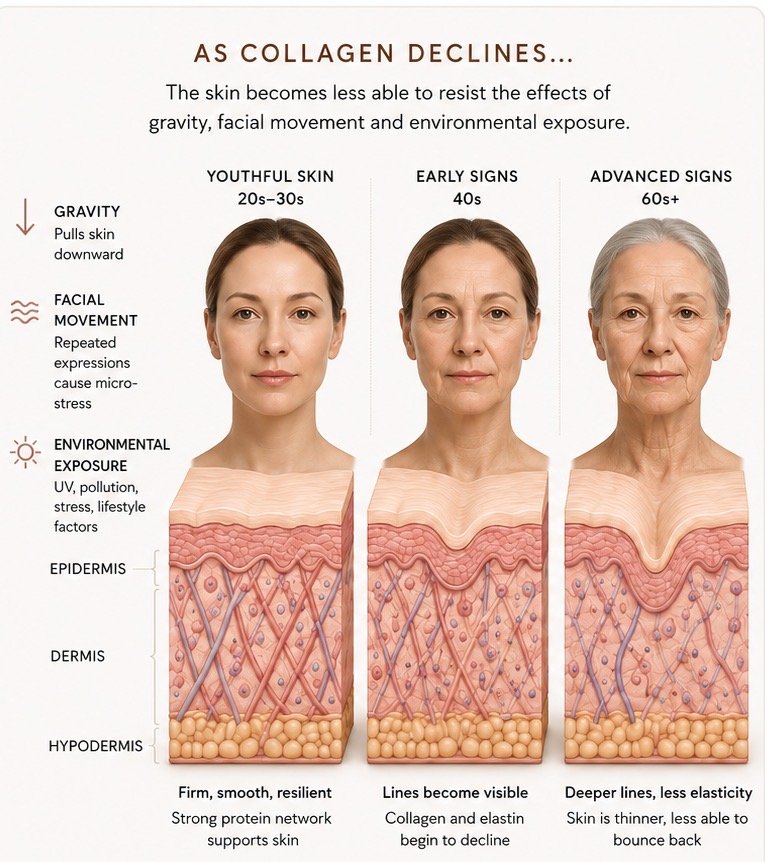
If I had to identify one structural change that contributes significantly to skin ageing, it would be the gradual loss of collagen. Collagen provides much of the skin's strength and support. As collagen declines, the skin becomes less able to resist the effects of gravity, facial movement and environmental exposure. Lines become more visible and elasticity gradually diminishes. However, collagen is only part of the story.
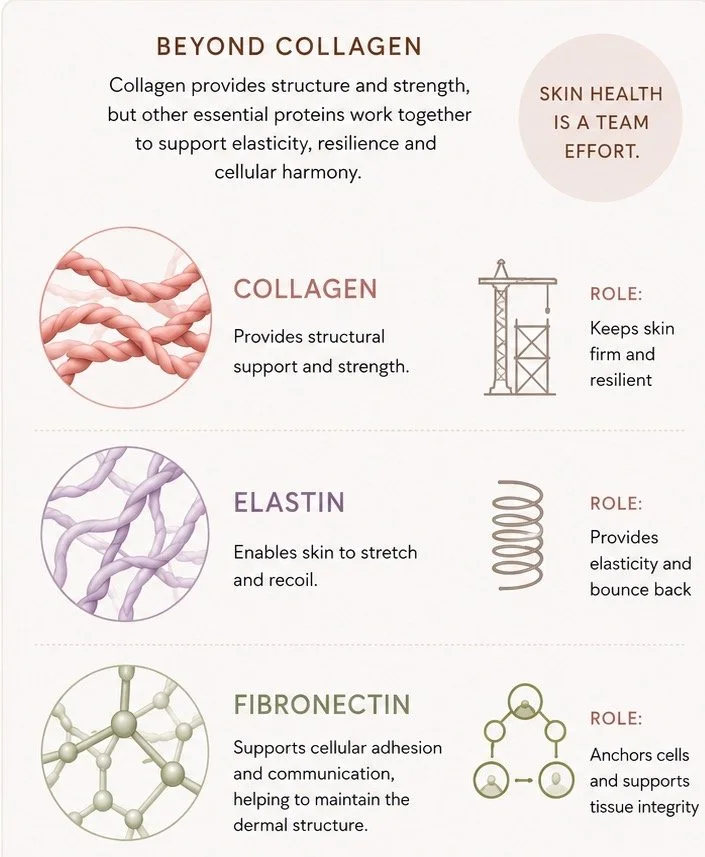
One of the misconceptions I occasionally encounter is the idea that skin ageing is simply a matter of collagen loss. Healthy skin depends upon more than collagen alone.
Proteins such as elastin and fibronectin also play important roles in elasticity, tissue support and cellular adhesion.
When discussing skin rejuvenation, my goal is not simply to increase collagen production. The broader objective is to support healthier skin function and improve the quality of the extracellular matrix as a whole.
Why Elasticity Changes
One of the first things I notice when comparing younger and older skin is a reduction in elasticity. Younger skin tends to recover quickly after movement and deformation.
As elasticity declines, the skin becomes less efficient at returning to its previous state. Lines that initially appear only during facial expression may gradually become visible at rest. Patients often describe this as their skin appearing less firm or less resilient. This is particularly noticeable around the eyes, where the skin is naturally thinner.
Why The Eyes Often Show Ageing First
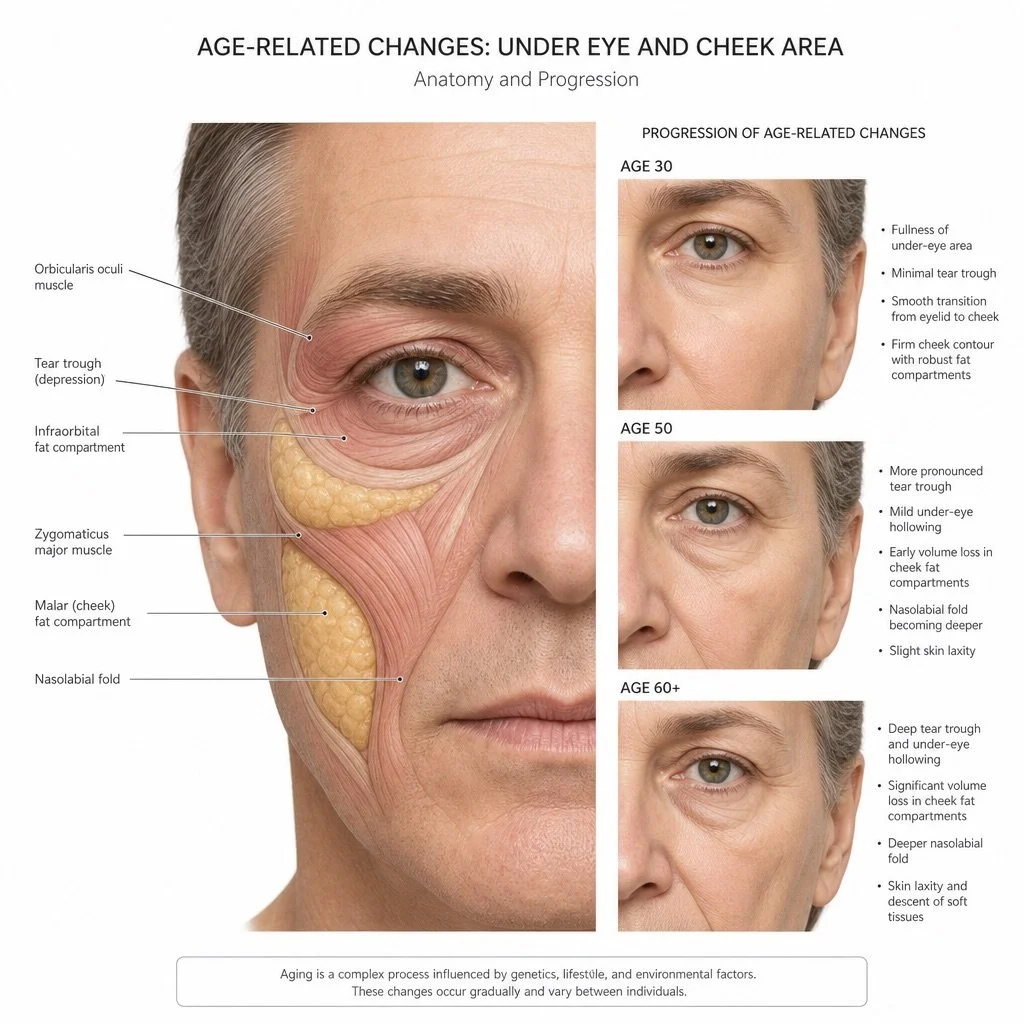
The eyes are the focal point of human interaction. When we speak to another person, our attention naturally gravitates towards the eye area. For this reason, relatively small changes around the eyes often attract disproportionate attention.
As skin becomes thinner and elasticity declines, expression lines may become more apparent. Changes beneath the eyes may become more visible. The result is that patients often notice ageing around the eyes before they notice it elsewhere.
The changes may be subtle.
The visibility of the area is not.
The Role Of Ultraviolet Exposure
If collagen loss is one major contributor to skin ageing, cumulative ultraviolet exposure is another. Many patients underestimate the influence of the Australian sun. Over decades, ultraviolet exposure contributes to pigmentation, wrinkles, reduced elasticity and changes in skin texture. It can also contribute to the development of benign skin lesions and, more importantly, potentially dangerous skin cancers.
In some men, chronic sun exposure contributes to thickened, coarse skin that appears significantly older than its chronological age. This is one reason why two individuals of the same age may appear remarkably different. Ageing is only part of the story. Environmental exposure matters as well.
Ageing Or Sun Damage?
Patients often assume that every visible skin change is caused by ageing. In reality, many of the changes they notice reflect years of cumulative sun exposure. Pigmentation is a good example.
When I see significant pigmentation, redness or uneven skin tone, my first thought is often ultraviolet exposure. I am also thinking about skin cancer screening, smoking history and other lifestyle factors that may be contributing to what I am seeing. The skin frequently tells the story of how it has been treated over many years.
Hormonal Changes In Women
Hormonal changes can also influence the ageing process. Around menopause, many women notice changes in skin quality that seem to occur more rapidly than before. Common observations include increased laxity, changes in hydration, breakouts and weight-related facial changes. These changes are often multifactorial. Hormonal influences may interact with collagen loss, environmental exposure and normal ageing processes simultaneously. For many women, this period represents a noticeable transition in how the skin behaves and responds.
How Men Age Differently
Male skin often follows a slightly different pattern. Compared with women, men frequently demonstrate greater cumulative ultraviolet damage, coarser wrinkles and more prominent static lines. One observation I hear regularly from male patients is that family members tell them they look angry even when they are relaxed. This is often not a reflection of how they feel. Rather, it reflects the way age-related changes and repeated facial movement alter resting facial appearance over time.
Skin ageing does not simply influence age perception. It can influence emotional perception as well.
Why Some People Age Better Than Others
Patients often ask whether ageing is simply genetic. My first question is usually what their parents look like. Genetics certainly matters. However, genetics rarely explains everything. More often, facial ageing reflects the combined effects of normal biological ageing and environmental exposure accumulated over decades. When I assess patients who appear to have aged particularly well, there are often some recurring themes.
Many have worn sunscreen consistently for years. Many maintain good hydration. Many follow a simple but consistent skincare routine involving cleansing and moisturising.
Interestingly, the patients who age well are often not doing extraordinary things. They are simply doing the basics consistently.
A Doctor's Perspective
One of the challenges with skin ageing is that it occurs gradually. Most patients do not notice the changes day by day. Instead, they compare photographs years apart and suddenly recognise the difference. By that stage, they are often seeing the cumulative effects of collagen decline, ultraviolet exposure, hormonal changes, environmental factors and normal ageing processes occurring together.
This is why skin ageing should not be viewed as a single event. It is a lifelong process. If patients take away one message from this discussion, I would like it to be this:
Skin ageing is normal.
Most visible ageing is cumulative.
And prevention is almost always easier than correction.