

What Is Skin Quality?
One of the more common comments I hear during a consultation is surprisingly difficult to define. Patients will often say to me:
"My skin just doesn't look as good as it used to."
When asked what they mean, the answers are usually remarkably consistent. They describe skin that appears dull. They notice more visible lines. Their makeup no longer sits smoothly. Lipstick begins to bleed into fine lines around the mouth, and their skin feels less plump than it once did. Some describe a loss of brightness or freshness without being able to really put a finger on it.
Interestingly, most patients are not talking about wrinkles alone. They are describing something broader, and that’s skin quality.
Skin Quality Is Not One Thing
One of the challenges with the term "skin quality" is that it is frequently used but rarely defined. Patients often assume it refers to hydration. Others think it means collagen. Some associate it with skincare products.
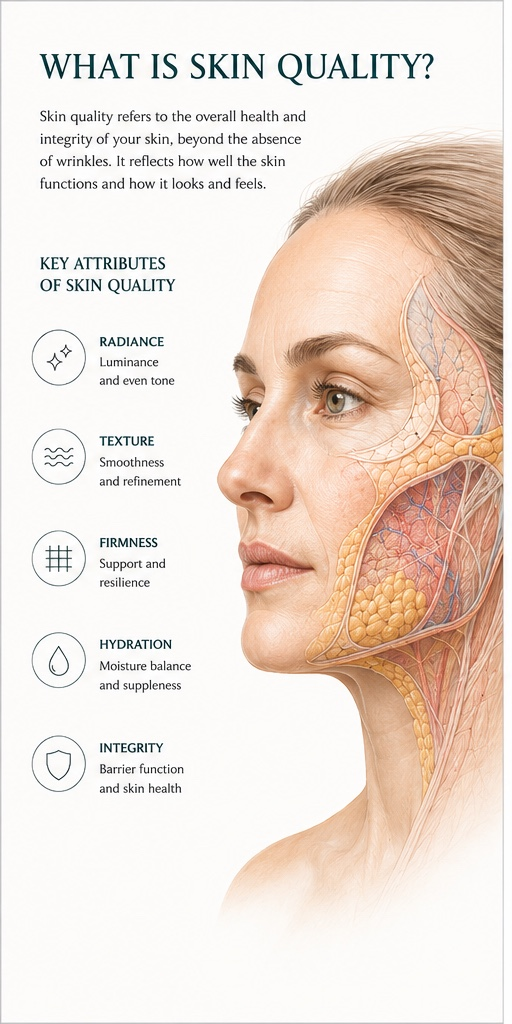
In reality, skin quality is a collection of characteristics that together influence how healthy, resilient and youthful the skin appears.
When I assess skin quality, I am not looking for a single feature. I’m assessing multiple aspects of the skin simultaneously, like texture, pigmentation and redness. I am considering hydration, elasticity, pore size and the presence of static lines. I am also assessing whether there are visible signs of inflammation occurring beneath the surface.
Good skin quality is rarely defined by any one characteristic. It is the overall impression created by all of these factors working together.
How Patients Describe Skin Quality
Patients rarely walk into a consultation asking about collagen, elastin or extracellular matrix biology. Instead, they describe practical observations, such as their skin appearing dull. Their makeup settles into lines. Their skin feels thinner, and they’re noticing increasing redness around the nose or cheeks. Their skin no longer appears as smooth or even as it once did.
These observations are usually accurate. Patients are recognising changes in skin quality even if they do not use that terminology.
What Does Good Skin Quality Look Like?
Most people can recognise healthy skin immediately, but they often struggle to explain why. When I see excellent skin quality, several characteristics are usually present.
The skin tone is relatively even. Hydration appears good. Elasticity is maintained. Redness is minimal. Static lines are less apparent. Texture appears smooth and pore size is often less noticeable. The skin simply appears healthy.
It appears youthful, hydrated and relaxed without obvious signs of inflammation occurring beneath the surface.
This observation is important because it highlights that skin quality is not simply about how old you are.
What I Look For During Assessment
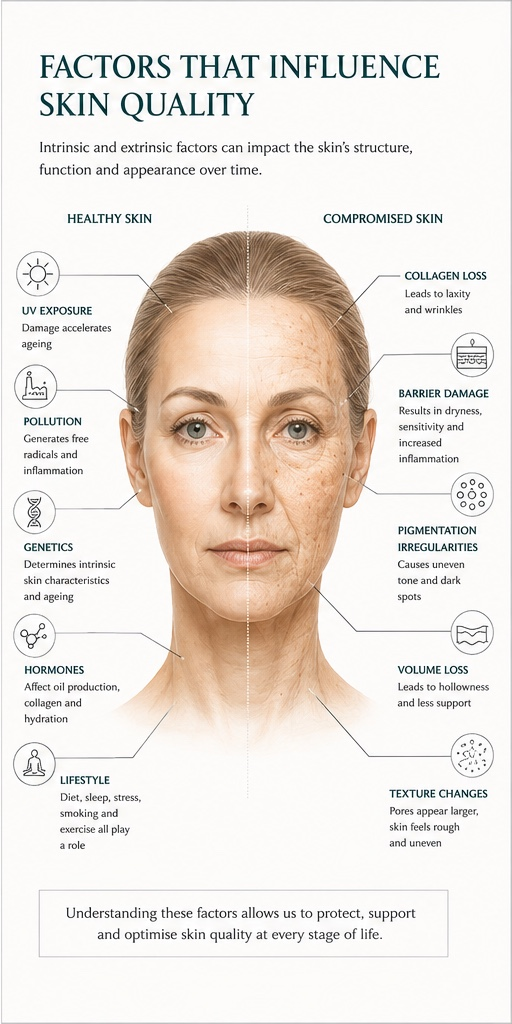
When I think a patient's concerns are primarily related to skin quality, there are usually several clues. Fine lines may be becoming more apparent. Skin tone may be inconsistent due to pigmentation or redness. Pores may appear more prominent. Breakouts or closed comedones may be present. Elasticity may be reduced, with the skin showing a delayed return during assessment. Darkening beneath the eyes may contribute to an overall appearance of fatigue.
Importantly, none of these observations exist in isolation.
The overall appearance of the skin is often determined by the interaction of multiple factors rather than a single dominant problem, and this can be why patients struggle to identify exactly what has changed.
The Importance Of Redness
One of the features I pay particular attention to is redness. Many patients view redness as a cosmetic issue. I often view it as a clue.
Redness frequently indicates that some form of inflammatory process may be occurring within the skin. Depending on the individual, this may reflect rosacea, environmental exposure, dehydration, illness, alcohol consumption or other lifestyle factors.
Because redness disrupts skin tone, it can significantly influence how healthy the skin appears, and patients can underestimate the contribution of inflammatory processes to their overall appearance.
Why Skin Quality Matters More Than Many People Realise
One of the more common observations I make is that patients frequently focus on volume when discussing facial ageing. About half the time, I find myself focusing on skin quality instead. The patient is usually noticing something real. They have correctly identified that they are unhappy with an aspect of their appearance, but, the primary issue is not always volume loss, for example.
More commonly, I may see changes in elasticity, hydration, pigmentation, redness or texture contributing to the overall concern. This distinction matters because volume and skin quality are not the same thing. Volume influences shape and contour, whereas skin quality influences how healthy, rested and youthful those contours appear.
A patient may have relatively good facial volume and still have poor skin quality. Conversely, a patient with mild volume changes may still appear remarkably youthful because their skin quality remains strong.
The Biggest Misconception About Skin Quality
Perhaps the most common misconception I encounter is the belief that one product or one treatment will solve every concern. Many patients arrive after years of trial and error. They have invested in skincare products, cosmetic treatments or procedures that promised significant improvement but ultimately failed to address the underlying issue.
The reality is that skin quality is multifactorial.
Pigmentation, redness, hydration, elasticity, texture and inflammation all contribute to the overall picture. For this reason, meaningful improvement often requires a structured and individualised approach rather than a single intervention.
A Doctor's Perspective
When I use the term skin quality, I am ultimately talking about rejuvenation. I am talking about the characteristics we associate with healthy, youthful skin: elasticity, hydration, even tone and resilience. Most patients recognise when these characteristics begin to change. What they often struggle to identify is why.
That is why assessment matters.
If patients take away one thing from this discussion, I would like them to understand that skin quality is rarely improved through a single product or a single treatment.
In most cases, meaningful improvement requires understanding the factors contributing to the problem first, then developing a structured approach that avoids unnecessary expense, unrealistic expectations and years of trial and error.