

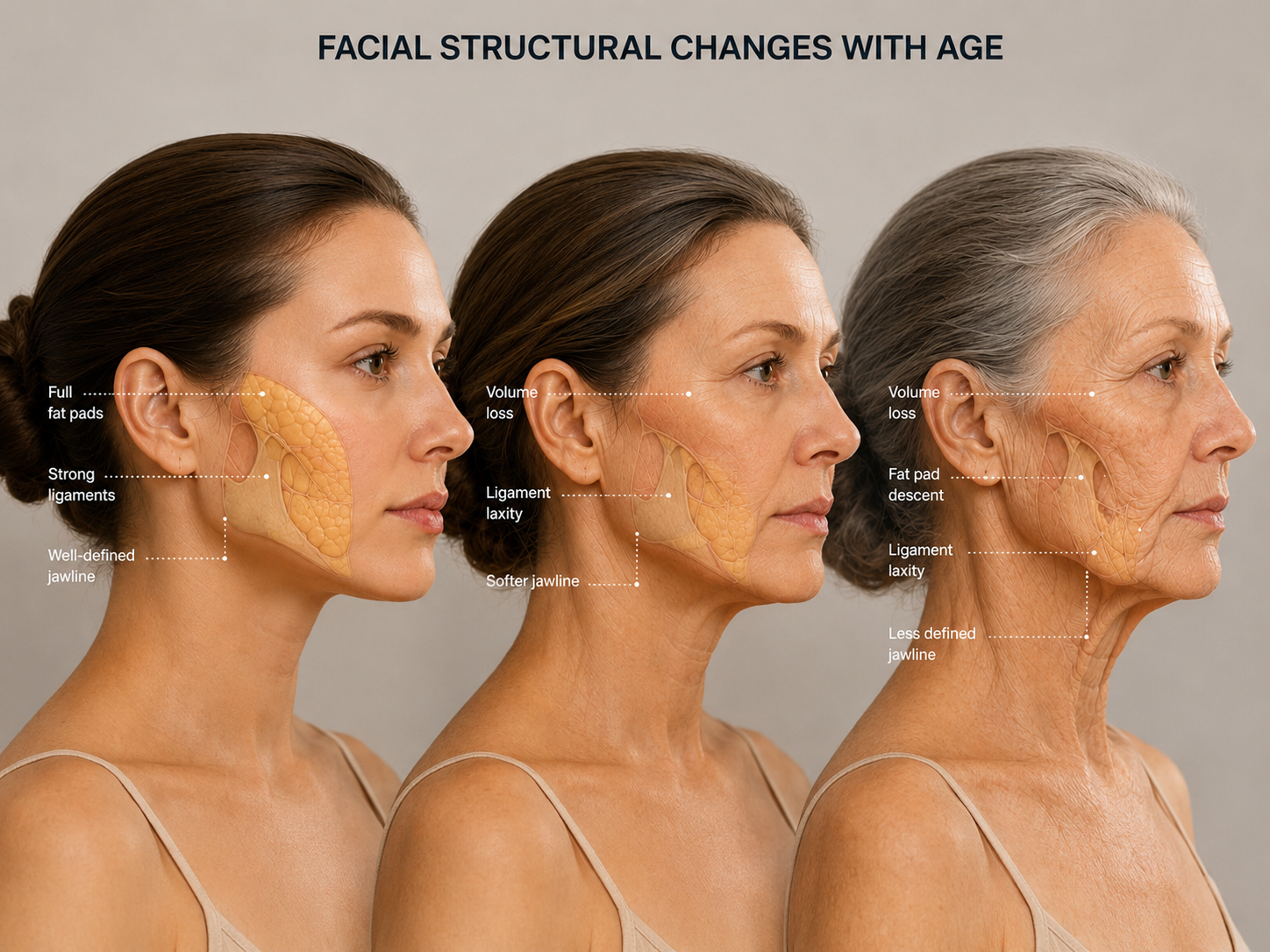
Why Do Faces Sag As We Age?
"My face is sagging."
In my clinic, patients usually point to the same areas; jowls, nasolabial folds, the lower face. Some feel as though their face is slowly "falling."
While these observations are understandable, they do not tell the whole story. One of the most important concepts in facial ageing is that the visible problem is often not where the ageing process began.
What People See
Most patients notice structural ageing through its consequences - a fold beside the mouth, heaviness along the jawline, shadows beneath the eyes. Common stuff, but concerning for some people.
Naturally, they assume the problem exists exactly where they are looking, but the face functions as a connected structure. Changes occurring in one area often influence another. This is why a fold, hollow or jowl is frequently the end result of structural changes occurring elsewhe
Sagging Is Not Just Gravity
Gravity certainly contributes but gravity alone does not explain what happens to the ageing face. Several support systems gradually become less effective over time. The skin loses elasticity, retaining ligaments provide less support, and fat compartments change position and volume. The facial skeleton slowly remodels. As these changes accumulate, the face becomes less capable of maintaining its youthful shape, and the result is what patients describe as sagging.
Why Jowls Develop
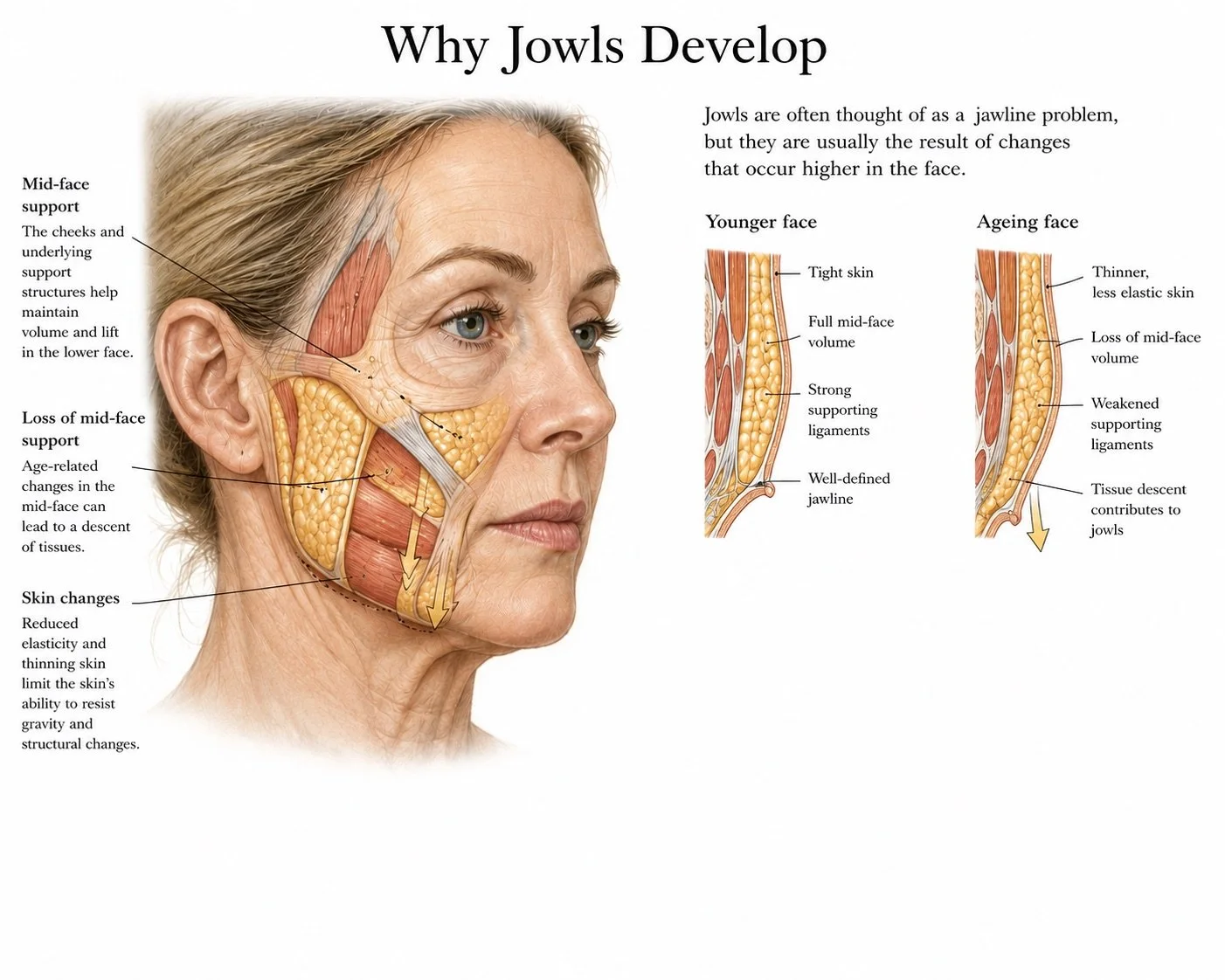
Jowls are one of the most common concerns in aesthetic medicine. Patients often view them as a jawline problem. I tend to think about them differently. When assessing jowls, my attention is often drawn first to skin quality and mid-face support rather than the jowl itself. Changes higher in the face can influence what happens lower down. Loss of support within the mid-face may contribute to increasing heaviness around the jawline. At the same time, declining skin elasticity reduces the skin's ability to resist these changes. This is one reason why treating the visible jowl alone may not always address the problem, and in fact, treating the jowl directly can lead to even more heaviness in the lower third of the face - this can make you look older!
Why Nasolabial Folds Become More Visible
Nasolabial folds provide another useful example. Patients commonly ask whether the fold itself should be treated. My first question is usually different: why has the fold become more prominent? Has support been lost within the cheeks? Have fat compartments changed? Has volume been lost around the piriform region? Has the overall structure of the face altered? The fold is often the consequence rather than the cause.
Volume Loss And Fat Pad Descent
One of the more surprising concepts for patients is that facial ageing is not always a matter of losing volume. Some fat compartments lose volume over time. Others descend. As a result, patients may simultaneously feel they have become hollow in one area while appearing heavier in another. This can seem contradictory until the underlying anatomy is understood. Facial ageing often involves both volume loss and volume shift occurring at the same time.
Why The Mid-Face Matters
One of the most interesting concepts in facial ageing is that support often begins higher in the face than patients realise. Many patients focus on the lower face because that is where they notice jowls or folds. During assessment, I frequently find myself examining the mid-face first. Changes within the cheeks can influence the appearance of the lower face. Improving support within the mid-face may sometimes influence how the lower face appears. This is one reason why a comprehensive facial assessment is so important.
Is Skin Tightening Enough?
Many patients understandably look for treatments that promise lifting and tightening. The challenge is that structural ageing involves more than the skin alone. Skin quality is important. Improvements in collagen production, hydration and elasticity may contribute to healthier skin and improve the tent canvas, to go back to an earlier analogy.
Structural ageing also involves deeper changes affecting fat compartments, retaining ligaments and the facial skeleton. This is one reason why improving skin quality does not always produce a dramatic lifting effect.

Why Patients Are Often Surprised
One of the most common observations I make during consultation is that patients have rarely been taught how the face changes over time. Mind you, I didn’t learn much about this at med school either!
People understand what they can see: A fold. A jowl. A shadow. A hollow.
What often surprises them is learning that these visible changes are connected to multiple biological processes occurring beneath the surface. Once patients understand this, many begin to see facial ageing differently, as I did.
A Doctor's Perspective
When patients tell me their face is sagging, I do not think about a single fold or a single treatment. I think about support. I think about skin elasticity, ligament function, fat compartment changes and structural foundations. Most importantly, I think about how these processes have interacted over many years to create the appearance the patient sees today.
What’s the take-away from this discussion?
Faces do not sag because of one process. They sag because multiple support structures gradually become less effective at the same time.