

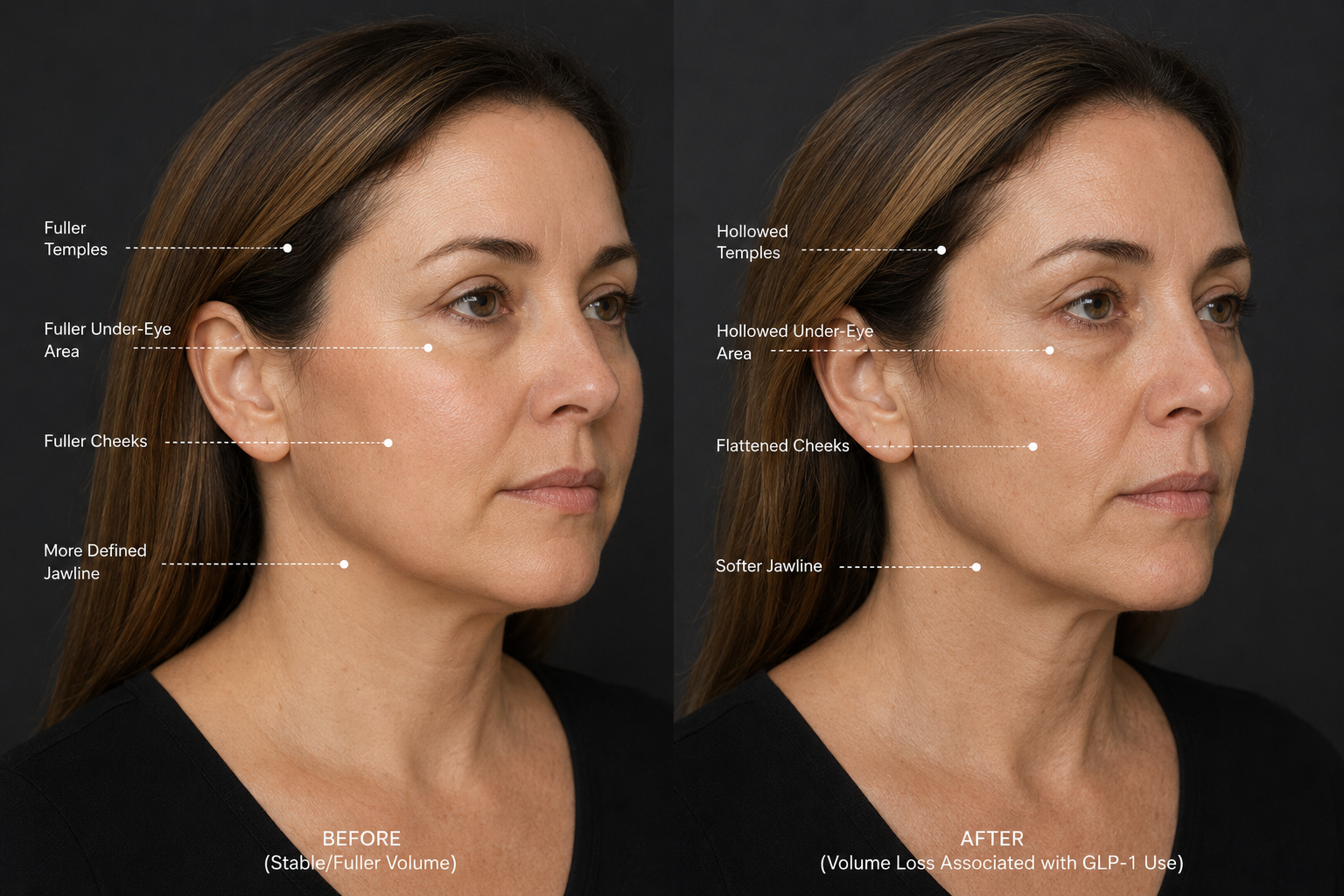
Why Does My Face Look Older After Weight Loss?
Significant weight loss can be an important achievement for many people.
Improved metabolic health, increased mobility and feeling more comfortable within your body are meaningful outcomes. Some people have noticed some unexpected changes. They feel healthier, but their face looks different.
Common descriptions include:
“My face suddenly looks older.”
“I look tired even though I feel better.”
“My cheeks have disappeared.”
“My skin feels looser.”
Recently, terms such as “Ozempic face” have become popular online to describe these changes, particularly as GLP-1 medications have become more commonly used for weight management.
These medications do not specifically target the face or directly cause facial aging. Significant weight reduction can reveal changes in facial structure, volume and skin quality that may already have been gradually developing over time. Understanding why this happens requires looking beneath the surface.
Facial Ageing Happens in Layers
The face is a complex structure made up of several interconnected layers:
skin
collagen and elastin support networks
superficial and deep fat compartments
facial muscles
ligaments
underlying bone structure
Each of these layers changes gradually with age.
Collagen production slows. Skin becomes thinner and less elastic. Facial fat compartments change. Bone support also remodels over time, particularly around areas such as the cheeks, jaw and eye region.
For many people these changes occur slowly enough that they are not immediately obvious.
Why Weight Loss Changes Facial Appearance
Fat plays an important structural role in the face. This does not mean that more facial fullness always looks better. Healthy facial ageing is about balance, proportion and support. The face contains organised fat compartments that contribute to shape and contour. These compartments influence areas such as:
cheek projection
the transition between the lower eyelid and cheek
facial curves
jawline definition
When overall body fat decreases, facial volume can also reduce. In some people this creates a more defined appearance, but in others, especially when combined with age-related changes, it can reveal:
flatter cheeks
deeper facial folds
hollowing beneath the eyes
increased skin laxity
changes around the jawline
The weight loss has not necessarily created these changes from nothing, but it may have uncovered changes that were previously less visible.
Why Some People Notice More Change Than Others
Not everyone experiences significant facial change after weight loss. Several factors influence how the face responds:
Genetics plays a role in facial shape, skin thickness and natural fat distribution.
Age is important because younger skin generally has greater collagen and elastic support.
The amount and rate of weight loss may also influence how much adaptation occurs.
Lifestyle factors including sun exposure, smoking, nutrition, sleep and general health all affect the skin’s ability to maintain and repair its supporting structures.
The Role of Skin Quality
Volume is only one part of the story.
After weight loss, many people focus on lost fullness, but you can’t ignore that changes in skin quality can contribute just as much to the appearance of ageing.
Healthy skin relies on a strong extracellular matrix containing proteins such as collagen and elastin. These structures provide firmness, elasticity and resilience. Over time, ageing and environmental exposure affect this support system. After weight loss, reduced underlying support may make existing skin changes more visible. Patients may notice:
thinner appearing skin
reduced firmness
fine lines
changes in texture
reduced elasticity
Replacing volume is not always the right answer.
Does the Face Need Volume Replacement After Weight Loss?
Sometimes carefully planned volume restoration can help, but we should never aim to recreate the face as it was before the weight loss. The goal is to assess what has actually changed. For some patients, the main issue is loss of structural support in areas such as the mid-face or temples and for others, improving skin quality may be more appropriate.
Many patients have a combination of changes involving skin, facial structure and general ageing. Adding volume without understanding the underlying cause can create an unnatural result.
A Healthier Way to Think About Facial Ageing After Weight Loss
Weight loss and facial ageing should not be viewed separately. The same principles that support long-term health also influence how we age externally:
maintaining muscle
supporting nutrition
protecting skin health
managing inflammation
preserving function over time.
Looking healthier and looking younger are not always the same thing. The aim is not to erase every sign of change, it’s to understand what has changed and make considered decisions based on your individual anatomy.
At Cosmenon, assessment comes first. By understanding your facial structure, skin quality and health journey, we can discuss options designed to support a natural, balanced appearance.