

Rosacea often begins as something that appears relatively simple: facial redness that lingers longer than expected, flushing that has become easier to trigger, or skin that suddenly stings when familiar products are applied.
The natural response is to look for something labelled calming, soothing or anti-redness. That can lead to an expanding routine filled with botanical extracts, corrective serums and green-tinted creams. For reactive skin, adding more products can create further irritation and make it harder to identify what is actually helping.
Rosacea can involve persistent redness, visible vessels, inflammatory papules and pustules, burning, dryness, swelling or eye symptoms. These features do not always occur together, and they may change over time.
A useful plan begins with the skin’s current presentation, not the number of products available to put on it.
Rosacea does not always fit neatly into one category.
Rosacea was traditionally divided into fixed subtypes. Contemporary clinical practice increasingly uses a phenotype-led approach, which means identifying the individual features present during assessment.
One patient may mainly experience episodic flushing. Another may have persistent background redness and visible vessels. Someone else may present with papules, pustules and marked sensitivity, while another person’s main difficulty is dryness and impaired barrier function.
These presentations require different priorities. A routine suitable for stable, dry skin may be poorly tolerated during an inflammatory flare. Products selected for oily or congested skin may aggravate someone whose face is burning and reactive.
The global ROSCO consensus supports assessing and managing rosacea according to the features present, rather than relying only on historical subtype labels.
“Clinical skincare” does not guarantee tolerance.
Professional skincare ranges can contain useful formulations, but the words clinical, professional or medical-grade do not make every product appropriate for every patient.
Fragrance, aromatic plant oils, alcohol, exfoliating acids and complex botanical mixtures may be tolerated by some people. They can also provoke burning, itching or increased redness in reactive skin.
Australian clinical guidance recommends a mild cleansing and moisturising routine while avoiding abrasives, fragrances and other potential irritants.
Ingredient lists provide useful information, although they cannot predict individual tolerance with certainty. The patient’s current skin condition, previous reactions and the way a product is introduced all matter.
For this reason, I would not describe an entire skincare range as “rosacea-safe”. I prefer to assess each product according to its formulation, its intended role and the person using it.
Your trigger list should be personal.
Heat, sunlight, alcohol, hot drinks, spicy food, exercise and emotional stress are commonly reported rosacea triggers. They don’t affect every person in the same way or to the same degree.
A long avoidance list can become burdensome without necessarily improving the skin. It’s usually more useful to look for reproducible patterns. I’ll ask you about them during your consultation.
A simple diary over several weeks can record:
flushing or inflammatory episodes;
food and alcohol consumption;
exercise and heat exposure;
skincare changes;
sun exposure;
stress, illness and sleep disruption.
When a pattern appears repeatedly, the trigger can be reduced, modified or managed more deliberately. Exercise, for example, may be better tolerated in a cooler environment, with breaks, airflow and cold fluids.
The purpose is to understand the skin rather than progressively restrict everyday life.
When skin burns or stings, simplify first.
A compromised skin barrier may present with burning, tightness, scaling or sensitivity to water and previously tolerated products.
This is usually the wrong time to introduce several active serums. A short, predictable routine makes it easier to support the skin and identify reactions.
A basic routine may include:
Morning:
A water rinse or tolerated gentle cleanser.
A simple hydrating or barrier-support product.
A tolerated broad-spectrum SPF 50 or SPF 50+ sunscreen.
Evening:
Gentle cleansing.
A simple moisturising or barrier-support product.
New products should be introduced individually. I generally prefer a limited-area trial for several applications before progressing to the full face. Leaving approximately one week between additions makes it easier to identify which product has caused a reaction.
If a product produces persistent burning, itching, swelling, scaling or increased inflammatory lesions, it should be stopped and the skin reassessed.
Daily photoprotection (SPF 50+) is an important part of rosacea care, particularly in Australia. The most useful sunscreen is one that provides appropriate protection and can be worn consistently without aggravating the skin. It’s such a personal choice that I have decided against stocking an SPF at Cosmenon.
Where selected Aspect DR products may fit.
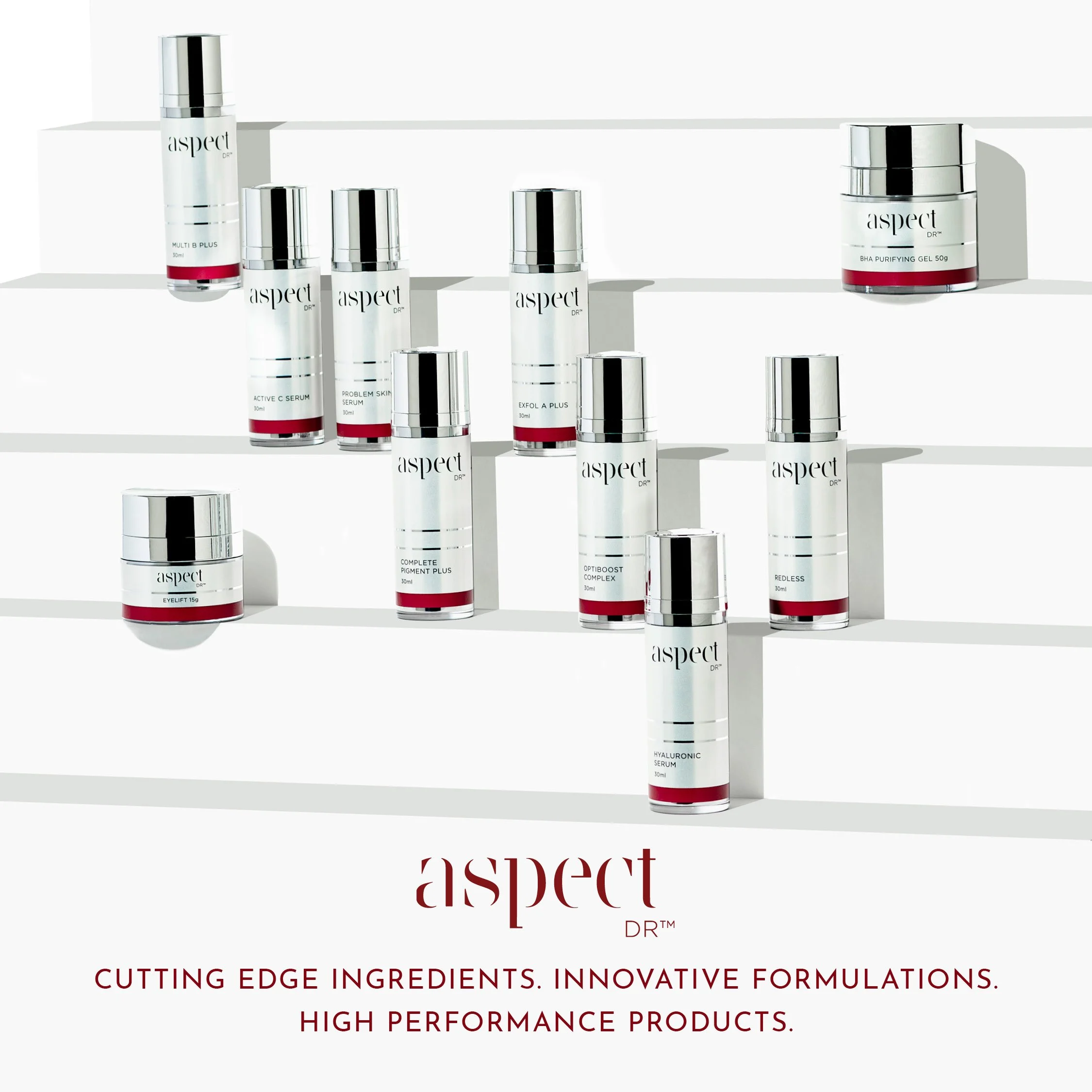
I am introducing selected Aspect DR products to the Cosmenon skincare range.
They will not be presented as treatments for rosacea or combined into a universal rosacea package. Their role is to support cleansing, hydration, barrier function and the visible condition of the skin.
Selection should remain individual.
Ceramide Serum
Ceramide Serum is likely to be the starting product for many patients whose main concerns are dryness, tightness or reduced barrier tolerance. Its formulation contains ceramides, cholesterol, fatty acids, glycerin and sodium hyaluronate. These ingredients can support hydration and the lipid structure of the outer skin.
It should not be described as curing rosacea or treating inflammatory disease. Its role within a potential protocol for you is supportive.
Penta-Hydration
Penta-Hydration may be considered when dehydration remains apparent after the skin has settled into a simple routine. It contains multiple humectant and barrier-support ingredients. Because rosacea-prone skin can react to otherwise well-tolerated formulations, I would still introduce it separately rather than layering it immediately with several other serums.
Optiboost
Optiboost may suit stable skin where additional hydration and antioxidant support are desired. It is not the first product I would introduce during marked burning, scaling or an active inflammatory flare. The core routine should be established first, followed by a gradual tolerance trial.
Redless Advanced
Despite its name, Redless Advanced should not be interpreted as a medical treatment for rosacea, flushing or visible facial vessels. Its place is more specific: an optional emollient step for selected patients with stable, dry or lipid-deficient skin. Oil-rich products can feel excessive on oily or inflamed skin, so it should not be automatically included in every routine.
Nurturing Cream Cleanser
Nurturing Cream Cleanser has a surfactant-free cream base and contains hydrating and lipid-support ingredients. It also contains aromatic components including cedarwood, mandarin and rosemary oils. Some patients may tolerate it well. Those with highly reactive skin or a history of fragrance sensitivity may require a simpler alternative.
Mild Clean
Mild Clean provides a light surfactant cleanse and contains glycerin and Canadian willowherb extract. It also contains tangerine peel oil and limonene. It may suit stable normal, combination or mildly oily skin after tolerance has been established. It’s less likely to be my first choice when the skin is burning, scaling or reacting to multiple products.
Skincare has limits.
Persistent papules or pustules, significant background erythema and troublesome flushing may require medical treatment. Skincare can sit alongside that treatment, but it should not delay appropriate diagnosis or create the impression that a cosmetic serum can control active disease.
Eye symptoms also deserve attention.
Ocular Rosacea may present with:
gritty, dry or burning eyes
recurrent eyelid inflammation
frequent styes or chalazia
conjunctival redness
light sensitivity
blurred or reduced vision.
Eye pain, marked light sensitivity or any change in vision requires prompt medical assessment.
Progressive skin thickening, an irregular surface or enlargement around the nose may indicate phymatous change and should also be medically assessed. These changes can’t be corrected with skincare alone.
A quieter approach usually works better.
Social media tends to reward elaborate routines, dramatic product claims and quick transformations. Rosacea care is usually less theatrical.
The routine needs a clear purpose. Products should be introduced slowly. Irritation should not be accepted as evidence that something is “working”, and persistent inflammatory or ocular symptoms should not be managed through online skincare advice alone.
At Cosmenon, selected Aspect Dr products will be used within an assessment-led skincare plan. For some patients, Ceramide Serum may be the only product added initially. Others may progress to Penta-Hydration, Optiboost or a more specific moisturising step once their skin is stable.
The number of products matters less than whether each product belongs in the routine.
When to arrange an assessment.
Consider medical assessment when you have:
persistent or worsening facial redness
recurrent papules or pustules
frequent burning, swelling or scaling
uncertainty about whether the condition is rosacea
eye or eyelid symptoms
progressive tissue thickening
reactions to several skincare products
symptoms that are not settling with a simple routine.
A consultation allows the skin pattern, medical history, current products and possible differential diagnoses to be reviewed before a plan is recommended.
This article provides general educational information and does not replace individual medical assessment. Rosacea presentations and product tolerance vary. Skincare products discussed here are intended to support the condition and appearance of the skin; they are not presented as treatments or cures for rosacea. Cosmenon has no relevant financial relationships or conflicts of interest to disclose regarding the products or companies mentioned in this article.